Elizabeth Holmes, 3D Mammograms, AI Medical Advice & Beauty Hacks

“Every time anyone has a conversation with you, you return to your definitions... It’s a way of protecting themselves so they don’t have to say, ‘I’m wrong.’”
- Chalene Johnson
episode
Description

Elizabeth Holmes invites cameras into her life before prison, but what exactly is Nathan Fielder capturing in You Can See Everything? Chalene Johnson shares what makes the documentary so hard to stop discussing, with a clear warning before the spoilers begin.

Chalene also unpacks 3D mammogram headlines, a survey in which 63% preferred waiting for human review of AI medical answers, and the backlash surrounding Hilary Swank’s pregnancy at 52. Loving Tan, Beauty by Earth, and a compact Nodpod round out her latest beauty and sleep finds.

Topics discussed: Theranos, Billy Evans, The Rehearsal, HBO, dense breast tissue, breast MRI, Cameron Diaz, self tanner contouring.

with
episode
Questions

Do you like combining AI with human medical advice?


Why does pregnancy after 50 attract so much judgment?


If you have seen “You Can See Everything” I need your thoughts!


episode
Timestamps
00:00:00

Breast health, AI, beauty, and Elizabeth Holmes

[00:00:00] Chalene Johnson : It is October and it’s Breast Cancer Awareness Month, and I’ve been trying to figure out which type of mammogram is the best type of mammogram. What do the studies say? Can you get your insurance company to pay for it? How do you get a 3D mammogram? Do I need an MRI? What’s the latest? We’re gonna cover that.

We’re also gonna talk about the difference between getting quick answers from your healthcare provider, that your healthcare provider is using AI to assist them with, versus your healthcare provider kind of going off their own personal knowledge and context, and which do you think people prefer and why?
I have some super juicy hooker hacks for you today, including my favorite self-tanners and how you can create a beautiful glowy look in just 10 minutes. My new favorite sleep device. Oh, it’s so delicious. It just, like, knocks you out. You’re gonna want one. We’re gonna talk about this trend of women in their 50s giving birth, deciding to get pregnant.

[00:01:00] Chalene Johnson : How are they doing this? Is it safe? What do people say about it? What do the fertility experts say? And at the very end, I’m gonna talk about this new documentary that everybody is talking about. It’s in the theaters right now. It’s the Elizabeth Holmes movie. And even if you haven’t seen the movie, the first little segment that I share with you, you wanna listen to it.

If you look down the show notes, I put a little time code so that you can dip out if you don’t want any of the spoilers, but I also give you a five-second warning before I share any of those things. But before I even get into the spoilers, there’s so much we need to talk about when it comes to Nathan Fielder.
Like, this documentary is absolutely groundbreaking. Oh, one more thing before we get into it, Patreon, 50% off this month. Just go to chalene.com/more. You can join Patreon for 50% off. It gives you access to all my back episodes. I will keep you company indefinitely. You get to hear the real juicy, behind-the-scenes, unfiltered, the tea.

[00:02:00] Chalene Johnson : And this week I’m gonna be sharing with you the latest in my therapy sessions. I have clarity like I’ve never had before after doing a medically supervised ketamine treatment this week, and I just have some real clarity. Still have work to do, but it’s really opened up my eyes and I think I’ve been focusing on maybe the wrong problem.

I don’t know if it’s a problem. The wrong part of myself. Anyways, more on that on Saturday. Warren is in town. We’re gonna celebrate his birthday. I’m trying to move. The furniture stories have gotten… With, like, trying to furnish this house and working with these different furniture companies, oh my, I’ve got so much.

I need a place where I can absolutely vent. So please, I would love to have you join us, chalene.com/more.


00:03:00

3D versus 2D mammograms

[00:03:00] Chalene Johnson : All right, we’ve got a lot to cover, so let’s get to it. I don’t know about you, but every time I go to get a mammogram, I think to myself, “Dang it, why am I here right now today?” And it’s the first day that I’m thinking to myself, “I should have scheduled a 3D mammogram, or should I look into 3D mammograms?”

Okay, well, there is a new study, and I’m gonna share the information with you. This study came out of Germany, nearly 100,000 women, that’s fantastic, ages 50 to 70. And what they did is compared the results of traditional 2D mammograms with 3D mammograms, okay? And you’re gonna hear this being reported, and I just wanna break down some of the numbers because when I first read it, I’m not great at math, I’m not a scientist, but these numbers, I’m like, “I don’t understand.”

Because they’re saying that the 3D group had approximately 24% fewer cancers discovered between screenings, but that that was not statistically significant. I’m like, “Huh? What are you even saying? If there’s 24% fewer cancers discovered between screenings, how is that statistically insignificant?” Okay, so let me break this down.

[00:04:00] Chalene Johnson : There’s an actual difference here. The actual difference was about four or five cancers, fewer cancers per 10,000 women with a negative screening. And researchers, of those four or five that were detected with a 3D mammogram, the researchers in the study looking at, again, over 100,000 women in the group, they couldn’t determine that those four or five were in fact detected because of the 3D mammogram.

And I’m like, “Huh? Why? What do you mean?” And the way it’s been described, I talked to my friend who is a researcher today, and he said, “Well, it’s kind of like flipping a coin. If you flip a coin 10 times and it naturally… One time you do the test of 10 flips, you get heads seven times, and then the next time you do it and you’ll get heads five times.

[00:05:00] Chalene Johnson : We just don’t have enough data yet.” I’m like, “Okay.” Earlier results from the same trial found that 3D mammograms detected 48% more invasive cancers at the initial screening. This follow-up asked kind of a different question. So in this follow-up study, the question was whether fewer cancers appeared, are you following, between screenings, where the evidence was less conclusive.

Now, why this matters, it takes multiple images from lots of different angles. Therefore, a 3D mammogram can reveal smaller cancers hidden between overlapping breast tissue. To me, it just seems obvious. Like, wouldn’t a 3D be just so much better? Apparently we needed a study to prove it, but now some people are reporting the study saying, “Yeah, it’s overrated.”

[00:06:00] Chalene Johnson : But it detects more cancers overall than traditional 2D, and it can reduce unnecessary callbacks. That seems particularly helpful when women have, like, super dense breast tissue. But what critics keep pointing out is that there’s no proof yet that 3D mammograms save more lives than 2D, and I think even that requires some nuance.

Is that because we don’t have as many women doing 3D mammograms? And isn’t that also the case because insurance, I’m sure, I don’t know this, but I w- would assume 3D mammograms, not all insurance carriers cover it. I don’t know how much of that is out of pocket. I don’t know the answers to that. But it just seems to me that if there is a technology that helps us to find cancers earlier, and I don’t know, there’s something that makes me a little uncomfortable about calling even one death statistically insignificant.

[00:07:00] Chalene Johnson : It’s like, what are we trying to do here? What is going on here? My first thought is, and not to be a conspiracy theorist, but it’s probably more expensive. The insurance companies probably don’t wanna pay for it. And sure enough, when I looked into it, many insurance companies don’t cover the 3D, and so of course they’re gonna want a study that’s like, “Well, it’s, you know, we, we don’t know that it’s better.

Seems to be a little bit better, but not enough so that we’re gonna pay for it.” If it were me, my next mammogram will be a 3D mammogram, and I think these headlines could discourage women from choosing to make that decision. And I think we need to be well informed. And maybe if you have no fears whatsoever, and you’re young, and you don’t have dense breast tissue, and there is no history of breast cancer in your family, yeah, and money is tight, well, okay, then get a 2D over not getting a mammogram at all.


00:08:00

Dense breasts, breast MRI, and screening options

[00:08:00] Chalene Johnson : But if it’s important to you, and you have the income, you’ve got the ability to, and, or if it’s covered by your insurance, then get the 3D mammogram, because these headlines are kinda ridiculous. We have substantial evidence that 3D does detect more cancers, so the debate is whether it improves long-term outcomes.

I don’t know why that is the debate. It shouldn’t be the debate, because the mammogram is to detect it, not to treat it. So here’s what I think women need to know. If you are at average risk- I think a 3D mammogram is a reasonable choice over a traditional 2D. If you have dense breast tissue, maybe you should ask whether additional screening is gonna help.

If you’re high risk, an MRI plus a mammogram might be recommended. And for people with extremely dense breast tissue, it seems as though, again, I’m not the expert, but it seems as though, in the prep I did for the show, the MRI detects cancers that sometimes a mammogram is gonna miss. An MRI is definitely more sensitive, but also that means it could increase false alarms, maybe even unnecessary biopsies.

[00:09:00] Chalene Johnson : My thing is, like, whenever I go to even my dermatologist, any tumor, any mole, any- anything, I’m like, “Just cut it out. Cut it out.” I actually do the same thing with Penelope. I mean, anything now that feels a little bit… Like, we just took her in last week and had them remove a little ball of fat, uh, because I’m like, “This feels like a lump.

I’m not gonna take any chances.” Most important question, I think, is if you’re getting mammograms. That’s the key, and whether you’re getting the right combination of screening for your individual risk. Breast cancer organizations, what do they say? They pretty much agree that the 3D mammograms are the best way to go.

[00:10:00] Chalene Johnson : The American Cancer Society says both 2D and 3D are acceptable, but that 3D detects more cancers and it reduces callbacks. Susan G. Komen says both are acceptable, but also recognizes that the 3D is, you get better results. Bottom line, if you can get a 3D, get a 3D. And I’m glad I did a little bit of research for this, because I’m gonna be asking for a 3D at my next mammogram appointment.

It’s, because I didn’t realize it was so easy. All you do is call your usual mammogram facility, or they, you know, a lot of them have, like, online scheduling now, and you just ask for the 3D mammogram. It’s not that hard. Typically, you don’t have to go to a new place. They have them there. They sometimes call it a DBT, digital breast, big long word that starts with a T that I can’t pronounce, and you just confirm your appointment that it’s for 3D, ’cause sometimes your doctor’s already scheduled you a 3D.

You might check there first. And then ask whether your insurance covers 3D, and if you need a doctor’s order, and you would do the exact same thing if it’s an MRI that you’re interested in. Now, if you have a new lump or any discharge in your nipples or any other kind of like, okay, something’s different with my breasts, tell the facility.


00:11:00

Organizing medical records with AI

[00:11:00] Chalene Johnson : Tell your doctor. You might need to do a diagnostic mammogram rather than a routine screening. Oh, and hey, one more tip. Take your last results from your mammogram, upload them to your AI, if you’re comfortable doing that. I am. Like, what do I care if AI knows about my mammogram results? Upload it, and then find out if you did get 3D in your last one.

That would be kind of interesting to see. And if your previous mammogram was done elsewhere, have the images transferred to the new radiologist so they can compare them. It’s actually one of my absolute favorite uses of my AI assistant, is I have her go through, follow this prompt. I had my AI assistant, I gave her access to my Gmail account and said, “Go through every single Gmail in the last five years, and I want you to download and save all of my medical reports, any PDFs, any attachments.

[00:12:00] Chalene Johnson : If there are portals that I need to sign into, notify me.” And now I have my own medical records, ’cause it felt like they were scattered all over California and Florida and France like, everywhere that I’ve been, the medical records. I wanted them all in one place, including all of the Any medical treatment, any surgeries, any medications are all nicely organized now. And whenever I go to see a new physician, and they send you that intake form, now I just have my AI assistant fill out the form using my medical records. It is a game-changer how much time it saves.

Another thing you need to be aware of as we’re aging, especially women, is our gut health, right? So one of the things I’ve learned in interviewing so many of these doctors and experts is our bodies just do not absorb nutrients the same way.

[00:13:00] Chalene Johnson : So it’s not just about eating the protein, it’s making sure that you’ve got a healthy gut lining and that you’re actually breaking down the protein. And how do you know if you’re not, right? Well, a couple things. If you feel incredibly bloated, you just are like, “My stomach feels hard,” like you’re– didn’t overeat the day before, you know you’re eating something healthy, but, like, your stomach just feels, like, distended and hard.

That’s one way of knowing. Obviously, if you’re gassy. And all of these things are signs that your body might be having a difficult time breaking down the enzymes in meats especially. Proteins are more challenging to break down, and so you are burning more calories while you’re breaking them down. But if your body isn’t truly absorbing them, if your body doesn’t produce the enzymes you need to break those proteins down, then you’re not getting the same proteins in your diet that somebody else is eating the same foods. That is why I assume, in part, studies are showing that as we age, especially women, we need to increase our protein intake, like perhaps even beyond one gram per pound of lean body mass. So one of the things I started taking is an enzyme. It’s like a gut enzyme, basically. It helps you to break down any proteins.

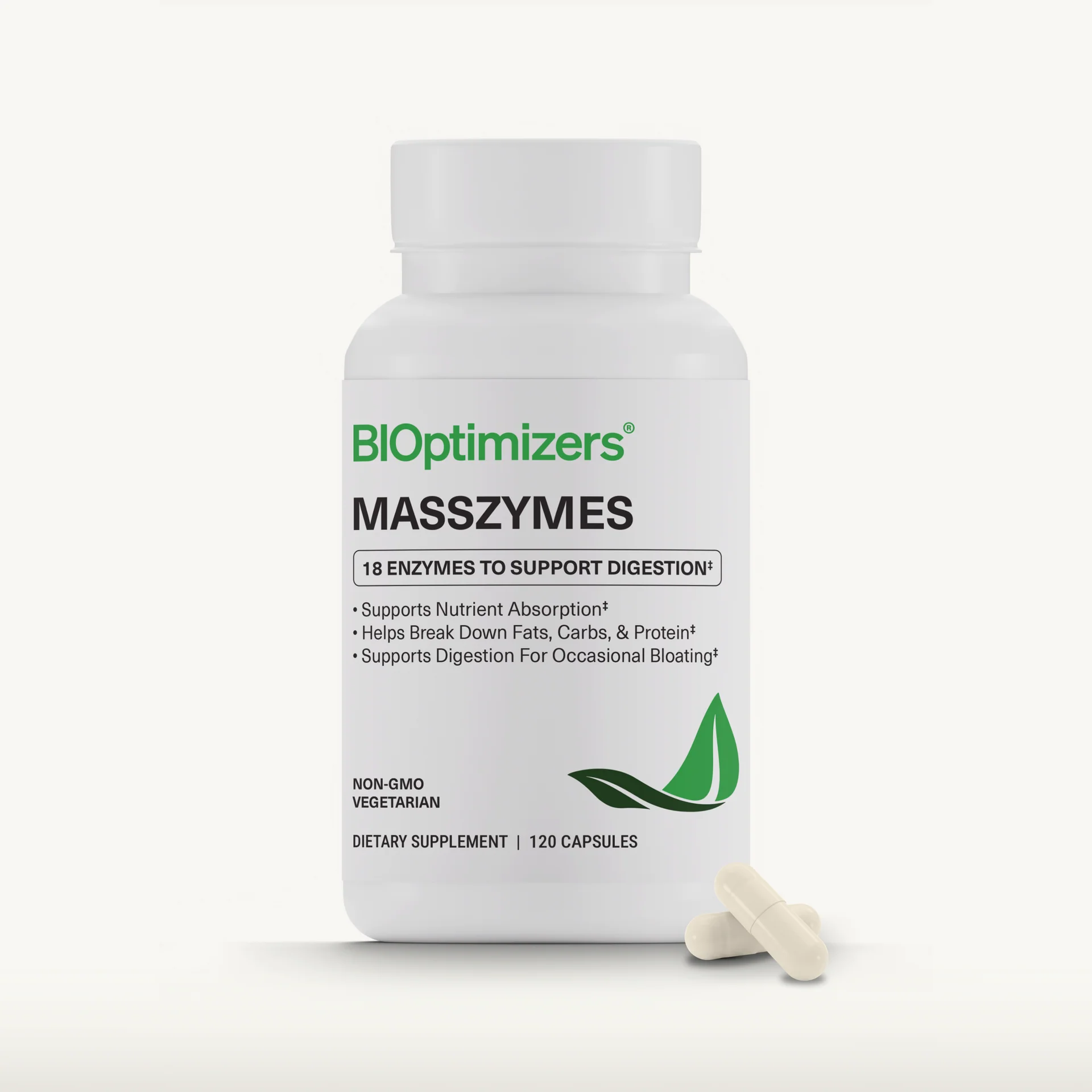
[00:14:00] Chalene Johnson : The thing I noticed right away is flatter stomach. Just because I love steak, I love chicken, I love meat proteins, animal proteins. I love the amino acid profiles of that. So I started taking what’s called Mazymes, meaning, like, enzymes. You just take three capsules, two to three capsules at each meal when you’re going to have protein, which hopefully is at each and every meal.

This has been a game changer, and I haven’t talked about it, and I realize, oh yeah, when someone asked me recently how I deal with the bloating related to protein, I’m like How have I never mentioned this? Anyways, if this is something you wanna try, BiOptimizers is a phenomenal sponsor of our show. We love BiOptimizers.

Why? Because if you don’t love this, they give you a 365-day money back guarantee. I love a company that’ll put a guarantee back on something like that, says a lot. I’ve met the founders of this company. I’ve had them on the show before. These are two people who are very dedicated to the research, like triple lab testing, everything, and they’ve just got some really remarkable products.

It’s called Masszymes, and you can get it by going to chalene.com/digest. How easy is that? chalene.com/digest. That gets you 10% off. So again, it’s chalene.com/digest.


00:15:00

AI medical advice versus human review

[00:15:00] Chalene Johnson : Speaking of AI and your medical records, this was a very interesting study. Okay, so if you’ve ever sent a question off to your doctor, like through the portal, you know what I mean? Like, especially if you do telehealth or if your provider is kind of like up to date, and you’ve got like a portal where you can ask questions, and you’ve ever got an answer back like weirdly fast, like, “Well, that was strange. I mean, I just sent it, and it’s lunch, and I got an answer back in five minutes.”

[00:16:00] Chalene Johnson : I want you to hear about this study. It came out on October 14th, just last week in JAMA. This is from researchers from Columbia’s Nursing School at Vanderbilt, and they asked 1,200 adults a pretty simple question: If you message your doctor’s office, do you want a quick answer written by AI, or do you want an answer that might take 48 hours, but it’s been reviewed by a human Guess what people said?

Well, I know you know the answer ’cause you probably answered it the same. 63% of people said, “I will wait. I would rather have a human review my answers.” Now, that’s pretty fricking interesting because statistically, we’re hearing anyways, that AI is incredibly accurate when it comes to medical advice, far more so currently than humans.

I mean, there’s only so much knowledge humans have, but by the same token, what humans have that AI don’t is context. They don’t know you personally. They don’t know your history. They don’t know all the things that make us feel comfortable, which are some of the reasons why we choose our human doctors for their bedside manner.


00:17:00

Waymo versus Uber in Miami

[00:17:00] Chalene Johnson : These robots that Elon Musk is developing and everybody else in China, they don’t look like they have exactly a lot of bedside manner. Am I right? But a couple things I wanna be really clear, because I don’t want this to turn into like, oh, AI is bad or AI is great. It’s just a survey, and I think our beliefs around AI and things that are automated, they can shift and they can change.

[00:18:00] Chalene Johnson : I remember the first time I heard about automated, like self-driving cars, and I’m like, “Oh, hell to the no. Hell no But now, I personally, where I live, would prefer to take a Waymo than I would an Uber here in Miami. My own personal experiences, I know I’ve told this story, but just in case you’re new here, I had taken an Uber Black, which is as high as you can get, right?

It’s, like, the most expensive. Take an Uber Black to my doctor’s appointment because getting there is on this, like, sketchy part of the highway where it’s, like, you know, like, everything merges all at once, and you’re like, “Wait, which lane? Which is, which is north? Which is south? I don’t know,” and you start to freak out.

Okay, so I always take an Uber for anything that goes to this part of… I don’t even know what the highways are called, and I’ve lived here for three years. Sorry, I’m an idiot. Anyways, I’m in this Uber, and this guy, Uber Black, and the driver picks up a call, and there’s a woman screaming, blood-curdling screams, top of her lungs, like she’s dying. And he’s screaming at her, and I’m in the backseat, like, with my eyes bugging out of my head. Oh, did I mention it’s raining? Oh, and then he says, “I’m sorry. I’m sorry. My wife is dying.” Now in my mind, I’m like, “Okay, so hang up and call 911. But also, what do you want me to do?” And he pulls over onto the shoulder on the highway and tells me I have to get out.

[00:19:00] Chalene Johnson : And I said, “Get out? What?” He goes, “Oh, you come with me?” Like, he didn’t speak English. So I’m, I’m using my translator at my Apple phone. And I’m like, I didn’t know if his wife was really getting murdered or if there was, like, a language barrier. I think- In my brain, the story I told myself is she was having a baby.

I don’t know why. Like, I could hear another baby in the background crying, and it sounded… There’s something about her voice that was like, oh, this is labor pain. I don’t know. I could be wrong. Either way, I was on the side of the road, and I had to call another Uber to pick me up on the side of the highway.
Mm-hmm. Oh my God, I have so many ridiculous Uber stories here in Miami. I’ve had Uber drivers pick me up where I’m like, “Okay, you are not the person that’s on this little screen. Like, you’re not that same person.” I’ve had guys hit on me. Like, Uber here in Miami is sketch. It is so bad. You can take the highest one.

[00:20:00] Chalene Johnson : I’ve had Uber drivers, like, almost get in accidents, and they’re just like… It’s just a nightmare. I’m sorry, here in Miami. So I feel safer doing the George Jetson’s version of transportation. I just do. It’s so weird. I feel so safe when I get in one of those. And they get in accidents. I’ve seen all… You guys always send me the clips. I’ve seen the TikToks. I’ve seen them stuck. I’ve heard the horror stories. I get it. And every vehicle is also a deadly weapon, so of course. I mean, anytime you get in a vehicle, you risk, there’s a risk that you take. I just find, personally, I feel safer in a Waymo. So this is an example of a place where I’ve changed my perspective on something I said I would never do, that I actually feel safer with it. But when it comes to doing, like, my own research with AI, I’m still gonna do that before every doctor’s appointment, every veterinarian’s appointment. I record the meeting. Of course, I ask for permission.

[00:21:00] Chalene Johnson : I upload it to AI. I get my own questions from AI. I try to do it as respectfully as possible, ’cause I know that’s probably very annoying for doctors. There have been times where I’ve brought some questions to a provider, and they’ve been like, “That’s ridiculous. No, you got that from AI.” It makes me wonder if they’ve seen the most recent research. Like, there might be something in October, and I’m like, “This guy’s so busy. How would he have even seen this report that I’m referring to?”

I don’t know. For me personally, I don’t know how you feel about it, but I like a combination. I do think it is essential that we have human context with everything, whether it’s copywriting or your doctor or your vet or whatever. But correct me if I’m wrong. It is nice to feel more informed. It is nice to at least go, “Well, I’ve got a second opinion or a third opinion, or I’ve got some…

I can look at the research myself and I don’t even have to understand it. I can ask AI to pick it apart.” I don’t know. It’s helpful. It just, it feels like more information makes me feel more confident. How does it make you feel? Do you like the combo approach? Do you not trust AI at all? Do you trust AI more than the humans? I mean, let’s face it, AI can read hundreds of studies in a matter of minutes, but for some there’s still just major distrust. So what’s your opinion? I wanna know.


00:22:00

Hilary Swank and pregnancy at 52

[00:22:00] Chalene Johnson : Okay, Hilary Swank is pregnant again at age 52. So she announced it on Instagram on October 14th with this sweet little video of her and her husband dancing, and they had glow sticks, and they’re with their twins who are, I think they’re like three now. She had her twins when she was 48, and she has talked openly about this, that she froze her eggs at age 37. And this next baby is due in December. And of course, you know what the internet does. The internet freaks out and the internet likes to tell women that they are too old to do things. Too old. How selfish.

[00:23:00] Chalene Johnson : Of course, we’re never gonna hear that when an 85-year-old famous actor announces that he’s pregnant with his 23-year-old bride. I mean, let’s face it, there’s a, a major double standard. And a lot of the reason why there’s a backlash is because there’s still this belief around what 50 looks like, what 70 looks like. I just watched a clip Just before I started recording of one of my friends who’s in her 70s crushing it in the gym. I sh- give her a shout-out all the time. If you haven’t followed Carrie Sisson, I’m gonna put her Instagram profile in the show description. Go give her a follow. I mean, her body, holy cow.

[00:24:00] Chalene Johnson : But more than anything, it’s just, like, the vitality, the youth that we see today as examples of women in their 70s. When I was in my teens and 20s, I thought 70-year-olds were overweight, short gray hair, big soft billowy arms, a billowy body, complained about aches and pains, and just didn’t get off the couch much.

Because I looked at my family tree and people in the neighborhoods, you know, it’s what you see around you is what you believe to be the potential. And in, I think, probably the last couple of decades, we’ve just seen that people have modified their lifestyles and understand the importance of diet and exercise and nutrition and hormones and attitude, and just the attitudes of society helps you to feel more vivacious and younger, and that affects the way you live your life.
And so anyways, go give Carrie a follow. And so I look at someone like Carrie, and I’m like, I’m trying to picture her. Obviously, she had her kids much younger. I shouldn’t say obviously, but I’ll tell you, she had her kids much younger. But I’m like, “Okay, so if her kids right now… Let’s say she got pregnant at 50 something, and now she’s, like, I think, 72, 73.


00:25:00

Fertility expert on IVF and pregnancy after 50

[00:25:00] Chalene Johnson : So her kids, if she had gotten Pregnant at 50. You know, our kids would be, like, in their 20s. Th- there’s nothing weird about that. I think our beliefs are changing, and I think especially when we’re hearing about these celebrities. It’s what you’re gonna hear about in the news, but there’s other women getting pregnant in their late 40s and 50s and doing so by choice.

Things have changed and things have shifted, and I know people have their opinions, which is fine, but we also have questions. I think there are a lot of women struggling with fertility, and you hear a story like this, and it’s hard. It’s hard to imagine, and you’ve got questions. Here is a little clip from a gal by the name of Dr.Shaheen. She’s a fertility expert. You can follow her series on TikTok. Take a listen.

[00:26:00] Clip: When a pregnancy at 52 makes the headlines without context, it can leave a lot of my patients and a lot of people struggling to build their family with questions that are unresolved. I’m Dr. Laura Shaheen, a fertility specialist. This is a part of my series where I answer your questions. She has not disclosed how she conceived, but a lot of people are curious, and that’s what we’re here to talk about. Egg number and quality decline with age, and by mid-40s, most eggs are chromosomally abnormal. I don’t know Hilary’s particular case. She is not my patient. But I’ve helped a lot of people build families in their mid, late 40s, even early 50s, with help. Most people are conceiving with egg donation, so the person who’s getting pregnant is getting pregnant with an embryo that is made from a donor, who’s usually under the age of 30, and the partner who’s providing sperm.

Age of the egg is typically the biggest limiting factor of success with IVF. Age of the person getting pregnant or the person with the uterus is not usually a limiting factor, but there are other things to take into consideration. There are real risks getting pregnant in your 50s, including increased risk of complications with pregnancy, like gestational diabetes, preeclampsia, high blood pressure, pregnancy, increased risk of C-section, and much more.

There are ethical concerns as well. How do you balance the right of someone to build a family in their 50s with true health risks and thoughts for the future child? And let’s talk about the double standard. Men are celebrated for fathering children in their 50s, 60s, 70s, even 80s. Medicine is amazing. IVF success rates are better than ever before, but we do have our limits.
Knowing the facts can help you make the right decision for you.

[00:27:00] Chalene Johnson : So anyways, Hilary Swank announced this on The Drew Barrymore Show, and she was telling this story about how this woman, when she found out that Hilary was pregnant, said to her face, “You are too old.” How do I just know that this was a judgy aunt or something?
Oh, and this woman said, she explained that her father was her favorite person in the whole world, and that he died when she was 21, this woman who told her she was too old. And Hillary said, “I understand. I understand grief. I understand Wanting more time with another person that my father died when I was young too.


00:28:00

Motherhood after 40 and the age double standard

[00:28:00] Chalene Johnson : I think she said her father died when she was also in her early 20s, and she said that the way she looked at it was she was so grateful that she had been born to her father and that she had that time with him in her life, as opposed to not at all.

[00:28:30] Clip: There’s a lot of backlash women get for having children older, but not men, which is interesting. Oh my God. I mean, it is weird men have babies in their, like, 80s- Yeah … and I, that is not a euphemism or a joke. You had kids in your 40s and people weren’t always- Yeah … gracious about it. There’s one story that I found really interesting, and I think I was attracted to this particular story because this one woman said, “You know, how dare you.

[00:29:00] Clip: Like, you’re, you’re too old and you won’t be old enough when your kids are, are older.” And my, my dad was my favorite person and he died when I was, you know, in my 20s, like my early 20s and, and it’s just devastation. And, and I related to it because my dad has also passed, but he was one of my favorite people on earth. And so I, I was drawn to that, and I thought to myself, well, I would rather be born and have that person that was my favorite person and experience that than not at all. Do you know what I’m saying? So that’s how I took what she said.

[00:29:30] Chalene Johnson : Anyways, you remember I talked about the other person, the other female who’s pregnant, celebrity, in their 50s, Cameron Diaz. I think she’s 53. And in that episode I said, me personally, the person I am right now with two grown children and living my best life, no, I wouldn’t wanna get pregnant at 53. Hell no. However, if my life had gone very differently and I longed for this child, I felt like this person was missing and everything else, I checked the boxes.

[00:30:00] Chalene Johnson : I mean, let’s face it. If you’re very healthy, and you can afford to, and you have family around you, and don’t forget, I mean, we’re talking about wealthy people in this particular story, but they have access to all the best healthcare and testing and monitoring and support and all those things.

Nonetheless, there will still be and there still are people that just assume that it’s selfish to do to the children. But when I looked into it for the Cameron Diaz episode, I looked at the studies where they polled children of parents who were much older, like parents who they were not conceived until they’re in their late 40s, sometimes early 50s. The studies seem to report that these people suggest that they grew up in calmer, more stable homes The respondents said that their parents were more patient. I mean, I know I’ve become a more patient person as I age. But the respondents did say their parents’ mortality is something they think about often.

[00:31:00] Chalene Johnson : What that lady said was true, and what Hillary said is true. And, you know, everyone’s experience is their experience. And if you had kids at 22 or at 42 or you didn’t have kids at all, there’s somebody out there that’s gonna judge you, and you just need to do what’s right for you and your family and not worry about the rest of the world.

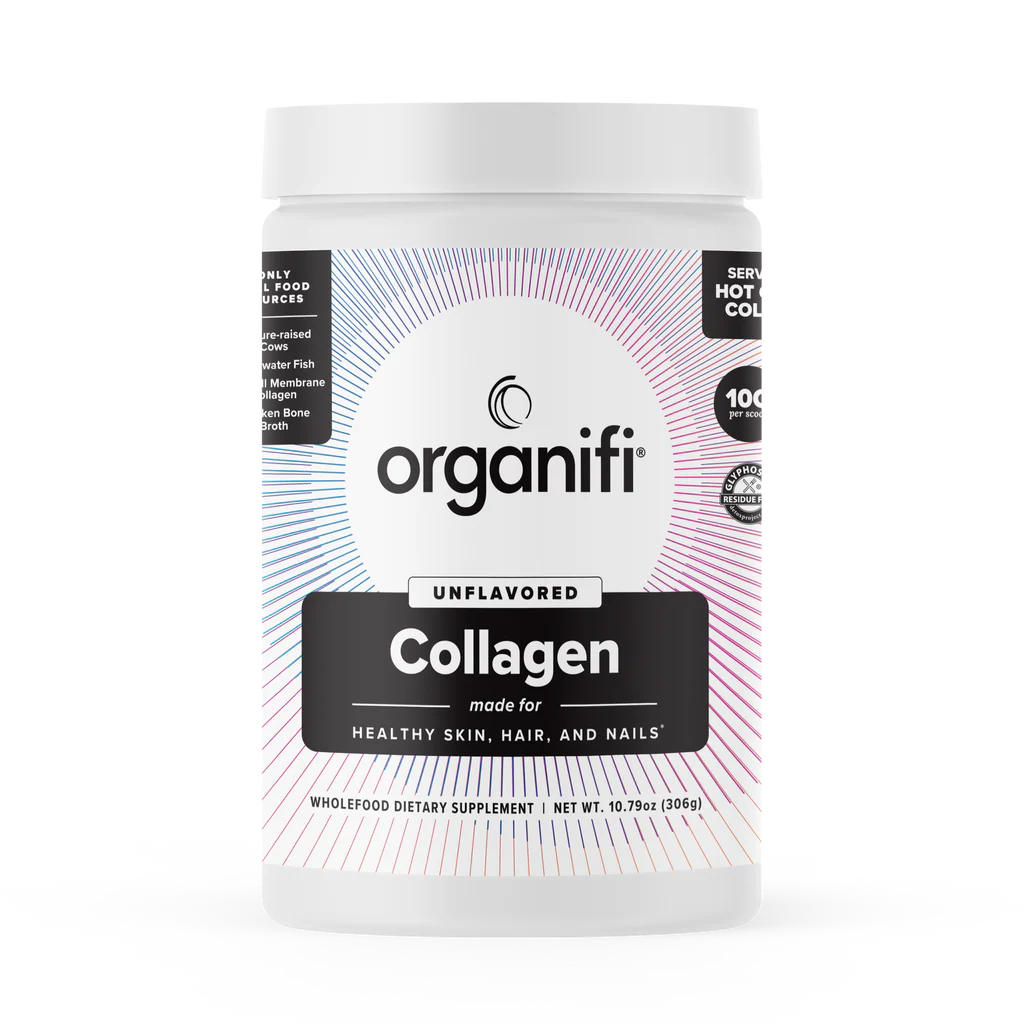
[00:31:25] Chalene Johnson : Ladies, the more research I do on collagen, the more I realize it just needs to be a must. We’ve gotta supplement with collagen, well, especially if you care about the texture and the tone of your skin, the way your hair grows, your nails. And all of these things become, like, an issue once we’re over 40, and it just feels like it goes downhill from there, which is why it is so important that you supplement with collagen.

It’s what the body uses for your joints, your muscles, your organs. It’s how you can support your gut health, your metabolism, your cardiovascular health, your immune system, and so much more. I have been getting mine from [00:32:00] Organifi. Obviously, you know I love Organifi. And as a listener of the Chalene Show, you get 20% off when you go to Organifi, O-R-G-A-N-I-F-I, .com/chalene. Use code Chalene. That gives you another 20% off at checkout. That is O-R-G-A-N-I-F-I .com/chalene. Use code Chalene for 20% off. Listen, get yourself some collagen. Make that a regular thing. I just mix in my water bottle every single morning and a few other supplements as well. And we love that Organifi is 100% certified organic.

It’s a great company with great products. Check ’em out. Again, organifi.com/chalene


00:33:00

Loving Tan and Beauty by Earth self tanners

[00:32:40] Chalene Johnson : I got a hooker hack for you. Okay, self-tanner. I had a bunch of people ask me about my favorite brand of self-tanner. Spoiler alert, I have a couple of different brands that I like and for different reasons. I have not found, like, the perfect self-tanner.

[00:33:00] Chalene Johnson : When I do, you will be the first to know. Okay, when I don’t want to be marinating in it all day, so say for example I’m gonna be getting on a flight, this is a lot of times when I self-tan because I’m getting on a flight, I’m going somewhere and I wanna be tan, but I don’t wanna be on an airplane all day in self-tanner.

So is it Loving Tan or Lovingly Tan? Loving Tan, I think it is. They sell a 10-minute tanner, but it’s a little bit deceptive. Let me explain. First of all, it’s kind of pricey. I think it’s like 50 bucks, but you’re gonna get probably four tans out of it, so maybe that’s not expensive. I don’t know. And you put it on.
There’s just a slight brown tint to it so that you can kind of tell where you’ve put it on, which is good, and it goes on like a gel. And then you leave it on for at least 10 minutes, and then shower it off, and then it is, what’s the word, it’s processing. So you won’t smell like a self-tanner. You won’t look like you’re tan either Because when you hear 10-Minute Tan, you’re like, “Oh, I’m gonna be tan in 10 minutes.”

[00:34:00] Chalene Johnson : No, you get to wash it off in 10 minutes. You’ll be tan the next day, okay? I will say this, I’ve tested it. I have worn it for 10 minutes and washed it off, and I was like, “This is not tan.” The next day I was, like, just slightly, like maybe 5% darker than my normal skin. Then I left it on for, like, three hours, and that looked really good.

I left it on for, like, five hours, and that was pretty dark. And then I experimented and left it on all day, and it was embarrassing. I mean, Brett was like, “Uh, you sure you wanna wear a, a dress?” I mean, my legs were like, “What are you doing?” It was so silly. Yeah, the longer you wear it, the more it processes, and that’s a good one, especially if you don’t wanna, like, again, get it on your clothes or whatever.

Okay, in full transparency, I have not looked at the ingredients. I know that’s highly irresponsible. I just cross my fingers and hope to God it doesn’t kill me, because I do enough other things to hopefully balance it out, but just joking. Like, I don’t know. Maybe it’s decent ingredients. I don’t know. I’m just being honest.


00:35:00

Self tanner contouring beauty hack

[00:35:00] Chalene Johnson : But this one, when I use it, the next one I’m gonna tell you about, I always feel like, “Oh, I’m, I’m just, I’m taking care of my health.” This is one that is fully non-toxic. It’s called Beauty by Earth. My sister swears by it, and I always forget about it. The only thing I don’t like about this particular self-tanner is it goes on with a mousse, and it has no color to it.

I love this one, except I’m always … I’m such a mess. I’m not precise about anything, and every single time I use it, I miss, like, the back of my calf or, like, a whole foot. Like this time when I put it on, this last time… I love the color, by the way, and it doesn’t smell, and it’s non-toxic, and it’s a nice color.

But when I put it on, I was like, “Okay, I’m gonna do my whole body, and then I’m gonna come back and just do, like, a light coat on my feet.” Well, I forgot to do the light coat on my feet, so it literally looks like I’m wearing white socks. But here’s my hooker hack. Use your self-tanner on your face, but not all over your face.

[00:36:00] Chalene Johnson : Just use it as your contour. It is amazing. You don’t even have to use a brush. What I do is I get one of those little makeup sponges, and I just dip the sponge in my, a little bit of self-tanner, and then I’ll do it just where I would normally put a little bit of a contour. And if you want, like you could even contour your nose.

For that, you probably wanna use a little bit of a makeup brush, and you’re gonna put it on, and you’re gonna look crazy. You’re gonna look insane, like dark lines, like war paint. Leave it. Let it dry for at least an hour, and then put your makeup on top of it, and it kinda like blends it. And no matter how crazy it looks, once you wash everything off at the end of the night, you’ll barely see it.

It’s just enough to make you kinda have a nice little glow and give you a nice little contour. I swear by it. I swear by it. Lately, I’ve just been putting a little bit of CC cream, that Tarte CC cream I talked about last week, on top of it, and you don’t even have to wear makeup. It’s money. By the way, I’m not trying to brag or toot my own horn, but let me just tell you, I am killing the documentary game right now.


00:37:00

Documentary recommendations and Nodpod

[00:37:00] Chalene Johnson : Woo. In large part, thanks to AI. AI, I have like set up this whole tracker, and it sends me all these alerts, and it’s finding documentaries that I actually love. I’m wasting far less time watching horrible duds because it’s getting better and better and better at like refining its recommendations, and also finding for me like hidden gems, documentaries that like most people miss because they came out on like a random platform, but they’re like sleepers, like the best documentaries.

And I recommend four every single week in my newsletter. You can get on my newsletter for free. I also recommend things that I have bought or purchased, sometimes they’re things I’ve shown on social media, sometimes I haven’t even had a chance to show you. Like the latest purchase that I need to tell you about is called a NodPod, N-O-D P-O-D.

[00:38:00] Chalene Johnson : And this is for those of you who did the weighted blanket thing for a little while like me. I love a weighted blanket, but I also hate a weighted blanket. Like I love it across my chest and my abdomen, but I get hot, or I feel like I’m being trapped, like a body is laying on top of me, and then I like tear a shoulder muscle trying to get the damn thing off of me.

So I have a love-hate relationship with weighted blankets. But this is like the same concept, except it’s about the size of like a bathmat and really heavy, and you just lay it over your chest. Girl, I am telling you- You will get the best sleep you’ve ever had, NodPod. They sell weighted eye masks too, but I’m not gonna do that because that would smush my DIY lashes.

Yeah, so get on the newsletter. Link is in the show description. Back to the documentaries. So I start getting messages, like four or five days ago, from friends saying, “Run, do not walk, and watch the Elizabeth Holmes documentary.” And I’m thinking to myself, “I already saw that documentary i- and I saw the movie, so no thanks.


00:39:00

Elizabeth Holmes documentary, spoiler free

[00:39:00] Chalene Johnson : I’m good.”But then I learn, no, this is different. And I’m gonna tell you the point at which you need to tune me out if you wanna go see it, and I hope that you do, in the theaters, and I’m gonna tell you why you need to see it in the theaters, and I’m gonna tell you enough about it to get you excited, and I’m also gonna tell you when to dip out if you wanna avoid the spoiler alerts.

Okay, I’m just gonna say, this is one of the strangest, most fascinating, and also funniest documentaries I’ve ever watched. Almost three hours long, but it feels like a psychological thriller. I am not kidding. And it’s so interesting to go watch it in a theater sitting next to other people. Like, I was looking at the couple next to me, and like when I’m leaning forward, they’re leaning forward.

When I’m like tilting my head and going, “Huh? Like, what?” They’re doing the same thing. It was cinematically unbelievable for a theater watch. Like, I just don’t know if it would have the same impact at home watching it.


00:40:00

Nathan Fielder and The Rehearsal

[00:40:00] Chalene Johnson : And I don’t know about you, but this is the second movie I’ve seen since COVID in the theaters, and when you’re watching this movie, it’s very different. So what the filmmaker has done is he’s moved in with Elizabeth Holmes and her boyfriend. She has just given birth, and I think it’s, like, I don’t know, maybe like four weeks before she has to surrender to go into federal prison. And if you thought you knew Elizabeth Holmes, let me tell you- This is a different Elizabeth Holmes. This is a different story. First, I wanna tell you a little bit about the filmmaker, okay? Because this is worth knowing about. I mean, I never talk about directors or filmmakers. This guy is, oh my God, I’m obsessed. His name is Nathan Fielder, and I’ve talked about him before because he had this show on HBO that I told you about, which I highly recommend right now.

[00:41:00] Chalene Johnson : So if you’re not gonna go see this in the theater, watch this series on HBO. It’s called The Rehearsal, okay? And you might remember me telling you about this. So it’s reality, but what he would do is he would take these people who had some kind of a difficult, either a difficult situation that was upcoming that they were dreading or something that they had been through.

Like, maybe they got in, like, this horrific fight with their best friend, and they never spoke again. And then he would build an entire replica of everything that happened around and involving the thing. Okay, so let’s say you had this horrible fight with your best friend, and it happened in a bar after work.
He would rebuild the bar exactly to a T. All the people who were in there, everything would be the same. And then for weeks, maybe even months, they recreate the same scene, and they go over it and over it and over it so that the person who had the trauma or drama or whatever would find a different way to process what happened and kind of change the meaning of it.

[00:42:00] Chalene Johnson : Or let’s say it was him recreating, like, maybe you… I can’t even remember any of the true examples on the show. But let’s say you had to come out of the closet. You had to tell your parents that you’re gay, and this is something you’ve just been dreading doing. Well, he would create, he would hire these actors to play your mom, let’s say, or your dad, and then he would have them rehearse in a scenario that looks exactly like your parents’ living room.

And he would week after week after week have you go through the same scenario, and, “Okay, here’s how you would respond if your mom says this. Here’s what you would say if your dad said this,” so that the person, by the time they actually went to go do the thing, there was like, they were completely calm because they already knew what to expect.

[00:43:00] Chalene Johnson : There was no anxiety. And I know that sounds strange, but you guys, you have to understand, this guy, Nathan, Nathan Fielder, is He’s a genius. That’s all I’m gonna say. He’s a genius, which is also one of the reasons why he’s so freaking funny, and he’s a big part of this series on HBO. Like, when you watch the HBO series, one of the best parts about it is him, ’cause he’s so freaking awkward and funny.
I don’t even know how to describe it. I’m telling you. So then he makes this documentary about Elizabeth Holmes, and just like the HBO series, he’s a big piece of it. So he’s got filmmakers there filming everything, and they’re filming him asking Elizabeth and her boyfriend questions, but it’s his reaction and, and h- how real and raw and just, like, awkward he is that makes it so fascinating. And the f- the cinematography is some of the best… Well, you’ve never seen cinematography this good in a documentary. I don’t think so. One of the things that makes him so fascinating, which is why I can’t even believe that Elizabeth and her boyfriend asked Nathan to do this.

[00:44:00] Chalene Johnson : I’ve got some serious takes on that too, but I don’t wanna give away too much, ’cause it would spoil, but it did kinda surprise me that they chose him. Because there are instances when you watch his HBO series where you sense that he has emotional intelligence through the roof, and that he can kinda see through people. Do you know what I mean? Which is very interesting, because the title of the movie is called You Can See Everything. And I will tell you this, there’s a scene in the movie where Elizabeth sends Nathan a text message that says, “You can see everything Did she mean you can stay, you can film everything, we’re not gonna hide anything, you can see everything?

That’s probably what most people feel like she was saying. I feel like she was saying, oh, you ac- you see everything.

[00:45:00] Chalene Johnson : You know, there are those people who, and maybe you’re one of them, that you can just see through people’s and you can see manipulation, and you can see lies. I don’t know. I think he’s one of those people, and that’s why you’re, you know, when you’re watching this documentary, you really watch his body language, you watch his face, and like he doesn’t have to say anything and you’re like, “Dude, I’m thinking the same thing.”
The reason why this documentary is, it’s, there’s never been a documentary like this before, and I don’t just mean because it’s good, but because of things he did in this documentary that have never been done before. And those are the parts I’m not gonna tell you because they would be spoilers. But I will say this: He definitely blurs the line between reality and performance.


00:46:00

Spoiler warning and Elizabeth Holmes documentary discussion

[00:46:00] Chalene Johnson : I will say that. He’s gonna make you question who is manipulating who, and there’s so many characters in this documentary, and they just keep peeling away layers and bringing in a new character and/or character development, like better than the best movie. Like, you’re like, I kept thinking to myself, “So this really happened.”

Okay, I want you to look at the timestamp, and if you have not yet seen this movie, you’re gonna need to dip out. And you want to, you want to dip out now and come back and enjoy the rest of the show where we’re gonna talk. ‘Cause listen, I promise you this, after you see it, you’re gonna be like, “I need to talk through this.” Now you have something to look forward to. And if you’ve already seen it, great. Here we go. This is your spoiler alert warning. You have five seconds to leave the room or put this on pause. And here we go. Okay, the crazy stuff, the crazy stuff that people are talking about. Billy Evans, that’s the boyfriend.

[00:47:00] Chalene Johnson : Dude, he is so obviously a narcissistic, controlling, power-hungry, insane… Okay, the nude scene, were you like, “What is going on?” Like, “Oh, hi, just a random penis.” And then how funny was it Nathan’s reaction? But I mean, like, what was that? What was that on behalf of Nathan Fielder, the director? And what was that on behalf of Billy?

Did Billy want that in there? Obviously, obviously. And, like, even his pose, what was that? Okay, I don’t have enough time to even talk about Billy. Oh, wait, did you stay to the very end and read the credits? I’m sure you did. Okay. But how about him, I don’t think he just loves Elizabeth, I think he wants to be Elizabeth. I think he wants to wear an Elizabeth skin suit and be Elizabeth I think that when he met her, he is a liar when he said, “I didn’t know who she was.” Dude, you just head toured her building in Silicon Valley. You live in Silicon Valley. There was nobody more famous other than Elon Musk at the time. Give me a break.

[00:48:00] Chalene Johnson :”Oh, I didn’t know, I didn’t know who she was. She had big glasses on.” Oh, okay. Yeah, her mouth isn’t real recognizable. Give me a break. No, you just lost my credibility. You lost all credibility there in the first interview with Nathan. And then I kept thinking to myself, and obviously Nathan was too, Nathan was asking our questions. Like, “So, what do you see in her?” Like, you get a lot of women. Obviously you’re a good-looking dude. You have a nice body, and here’s this woman who’s absolutely bankrupt and going to federal prison, and you’re like, “Give me some of that?” And he’s like, “I just fell in love with her at first sight.” Mm-mm. No, this is a power-hungry weirdo, in my opinion.

These are all just for entertainment purposes only. These are not facts. These are my opinions. Okay. Then who else are we gonna talk about? Elizabeth. So I watched the movie where Amanda, is it Seyfried? Is that how you say her name? Seyfried, Seyfried. I forget. I know they said it wrong in the movie. But anyways, I watched the movie about Elizabeth, which was done so well, and the documentaries.

[00:49:00] Chalene Johnson : And in the documentaries Elizabeth is so powerful, so commanding. You’d have to be to talk these billionaires into giving you billions of dollars, and to convince millions of people. Like, you have to be a powerhouse. You have to be a manipula- I mean, you have to be something. And in this movie, right, didn’t you think she just seemed like so broken and fragile? And at first I thought, tell me if you thought the same thing, when Nathan was interviewing her and the tears were welling up in her eyes, my very first thought was, acting. Oh, she’s, she’s learned how to cry on demand. That was my very first thought. And I thought, this is a performance for him. This is her way of making everybody feel very sorry for her.

[00:50:00] Chalene Johnson : She probably got pregnant to make, to change the narrative. It’s the only way that she could, ’cause this woman’s gonna do it again. And so the only way that she could really win over the public’s sentiment is using the mother card. And then to pull in this documentarian to show this human side of her, and she’s prepared.

And so I thought she was playing this role, but she never did break character. She was a broken bird from the very beginning. You could just tell. That’s just like a, a broken wanting to be controlled kind of woman, or is that just how she is with men? ‘Cause remember, Sunny, the guy that she started Theranos with, was I think like 20 some-odd years older than her, and allegedly, like, really abusive, really controlling. And people have said, like, he was the puppet master, and she just did everything he said God, and then what about the scene where the dad’s like, “And then there was Elizabeth’s rape,” and then they just dropped it. I don’t remember that part of the story, so I’ve gotta look that up. But, like, that was so weird.

[00:51:00] Chalene Johnson : They just, like, threw that out there and then dropped it off. And the parents, oh, I wanted more time with the parents, and the parents are scared of Billy, too. Why is everybody afraid of Billy? I’m afraid of Billy. I mean, Billy, please don’t come after me. But Elizabeth just broken and controlled. And so I guess, can you be a manipulating, lying narcissist yourself, but fall prey to someone, and then you slip into a different role?
I’m really curious about that. Thoughts? I mean, does she actually believe she’s innocent? What do you think? Hmm.

[00:52:00] Chalene Johnson : That I don’t have a clear answer. What do you think? Does Elizabeth Holmes thinks, does she think she is guilty? I think in kind of the same way OJ had convinced himself he didn’t do anything wrong, and he convinced himself, and I think Elizabeth has convinced herself.
I do. Now let’s talk about the who’s on first conversation, because that has been with me all day today. We saw the movie last night, and that, to me, 24 hours later, has a much bigger impact than when I watched it. First of all, that he chose that clip to explain or to try to help Elizabeth understand her style of communication was brilliant.

Because that is exactly how Elizabeth communicates, and that form of communication, in my opinion, feels very narcissistic. It’s when someone is not trying to help you understand something. They’re trying to hold onto their position by playing with words, by playing with definitions. That’s what that comedy routine is all about.

[00:53:00] Chalene Johnson : The point isn’t that she was like, “Oh, I’m literal.” No, that’s not the point. The point is that every time anyone has a conversation with you, you return to your definitions, and y- the words you’re using are meant to confuse people, and you just keep returning to these same words so that people’s questions go unanswered.

It’s a technique. It’s a way of, like, protecting their stance. It’s a way of protecting themselves so they don’t have to say, “Oh, I’m wrong.” She doesn’t have to say, “I lied,” because it’s like the Bill Clinton, “I was not having a relation with that woman,” or whatever his words were. It’s semantics so that they can profess to themselves and others, “I’ve never lied based on my definition of the words.” And that was the other thing. She said she never lied in her entire life. Like, what are you even… Like, that in and of itself is a lie. And then she’s like, “Well, I mean, in the way that you’ve defined it.” So there’s a whole lot of, like, how we’re defining language, and that’s self-protective. That is how she evades the truth.

[00:54:00] Chalene Johnson : It’s, she just confuses people so that she never has to give a clear answer, and then therefore she never has to be accountable. And you know, there’s that, and then she’s obviously on the spectrum. That’s clear that she doesn’t have a sense of self. It doesn’t seem like it. Or at least, again, is she playing a character?

That’s another… They kept talking about that. I’m like, it does feel like she’s playing a character, whether she ever said it or not, who cares? Who cares? Who cares whether she said it or not? It’s very clear that’s what she’s been doing And now is she playing a character in this documentary? I felt like she was. Like this broken, frizzy hair, giant blue … Like why are those eyes so freaking blue? Did he have some kind of filter on them? I feel like that was intentional. There had to have been some kind of filter on those eyes to make us feel some kind of way, because she played the broken, innocent victim breastfeeding mother to a T.

[00:55:00] Chalene Johnson : It really did feel like, okay, you’re really playing this mother card, aren’t ya? I don’t know, but like she’s also a mother, so is she playing a mother card? Is she playing a role? Does she even know who she is? Does she have a sense of self? And I’m not saying because she didn’t get the joke that that is why she’s unaware or neurodivergent.

I’m just saying like I just think she’s unaware in general. Like anyone who stares at you that long, I am so uncomfortable. And the head shaking, that felt like a, like early Parkinson’s or something. What is that? Does anyone know? That’s very strange that, that like just staring and the, the, the head nodding, like that’s so weird.

That’s a, gotta be a neurological thing. Okay. I haven’t heard anybody talk about this, but it’s something I picked up on and I’m wondering if you picked up on it.

[00:56:00] Chalene Johnson : I feel like Nathan, the director, was trying to plant a seed from one of the very first scenes, and I think this was very intentional on Nathan’s part, and that is he was trying to get the viewer to believe or to question whether there was some type of attraction between Nathan and Elizabeth.

If that weren’t the case … And well, let me give you some evidence of it. So number one, he kept in scenes like he said, “How do you flirt?” She said, “Oh, I just hold a stare.” And then she just held a stare with him for a really long time. And she, he’s like, “Oh, like this?” I mean, so there was that, and that was like right away early.

And then there were just a few other scenes where it was like very … He kept the scenes in. You know, like her asking him to go swimming, and then how intentional it was he played that at the end of the movie, the two of them like frolicking in the water together. The way he talked about her hug with him. The way he wrote his letter to her, and the things he said when they were on the phone together, like, “I miss you. It’s so good to hear your voice.” That’s not, that’s not something a journalist says. That is not something a journalist says, or a lawyer or, you know, anyone in a profession.

[00:57:00] Chalene Johnson : And then also when Amanda was introduced, right? And then Amanda was asking him, like, “Are you trying to protect her? You care about her And there are a few other things that, yeah, so obviously that was intentional. Don’t even question it. Nathan is a director. He kept that in there as a layer so that you would be thinking about this movie two weeks later.

That was a layer. The layer of, I mean, God, there were just so many layers to this thing. And just, okay, do you think Elizabeth knew that Billy had negotiated his own rate for the documentary? I don’t think she did, but did she know that there was gonna be a private conversation and he didn’t want her in the room?

[00:58:00] Chalene Johnson : Yes, I do think so, but I don’t think she knew if it was about money, ’cause I, I feel like that scene felt honest when she was like, “Well, I’m not making any money from this.” If you stayed all the way to the end and saw the credits, you saw that Billy did give up his rights to earn money on this movie, which I did find very fascinating.

I should have prepared before I recorded, but I, I’m curious if in doing so, did he also have to give up any executive producer rights where he didn’t have the ab- I, I’m sure he didn’t have the ability to screen this before it came out. The most fascinating piece about this documentary is it is about being manipulated.
Clearly, in my opinion, Billy is using Elizabeth because he’s power hungry and wants to be Elizabeth, and it’s just so exploitive. I just can’t even believe it. He’s a manipulator. The movie’s about manipulation.

[00:59:00] Chalene Johnson : Even Amanda, there were things that, uh, like I, I love her, I love her little personality, but there are parts in the way Nathan asked her questions where she kind of, like, didn’t have a good answer.

You know what I mean? And then were we being manipulated by Elizabeth? Were we be- being manipulated by Amanda? Were we, we being manipulated by Nathan? So here we are watching this documentary about manipulation, and what is the truth and what is real? We have to ask those same questions even about the filmmaker.

Ooh, it was good. It was good. I know you’ve already seen it or you wouldn’t have made it to this part of the episode, but I need to know, please, I hope you took notes, because we need to discuss each and every one of these points, and I bet there’s some points that I missed, so drop them in the comments.
All right. I love you. Thanks for listening, and I’ll talk to you soon.

connect with
Chalene
go beyond
The Podcast

The podcast is where the conversation starts. The after party continues inside our private community. Click the button below to join chalene on her private podcast:

TAKEAWAYS
REGISTRATION IS NOW OPEN!

Join The PodSquad on Facebook

We would love to hear from you!

Leave your questions or messages for Chalene

To advertise on our podcast,
please reach out to warren@chalenejohnson.com
and mention The Chalene Show

Join NEWSLETTER

Join my email list for free weekly tips and strategies on how to live your most productive, balanced and happy life!

© 2026 Chalene johnson all rights reserved.