Yo… we need to talk about peptides.
Because right now, this whole space is a mix of real science, wild marketing, and some straight-up questionable black market products that are flying under the radar.
And I’m not saying that lightly.
Let me be clear upfront: I am not anti-peptide. I take two specific peptides myself. With a doctor. Carefully. And I’ve talked about them openly before…including the fact that they are not FDA approved and that for me, it’s a calculated risk I’ve made with medical guidance.
What’s happening in the broader peptide world right now? That’s a completely different story. And honestly… it’s the part most people are not talking about loudly enough.
And you need to hear it. (Listen to the Chalene Show episode here).
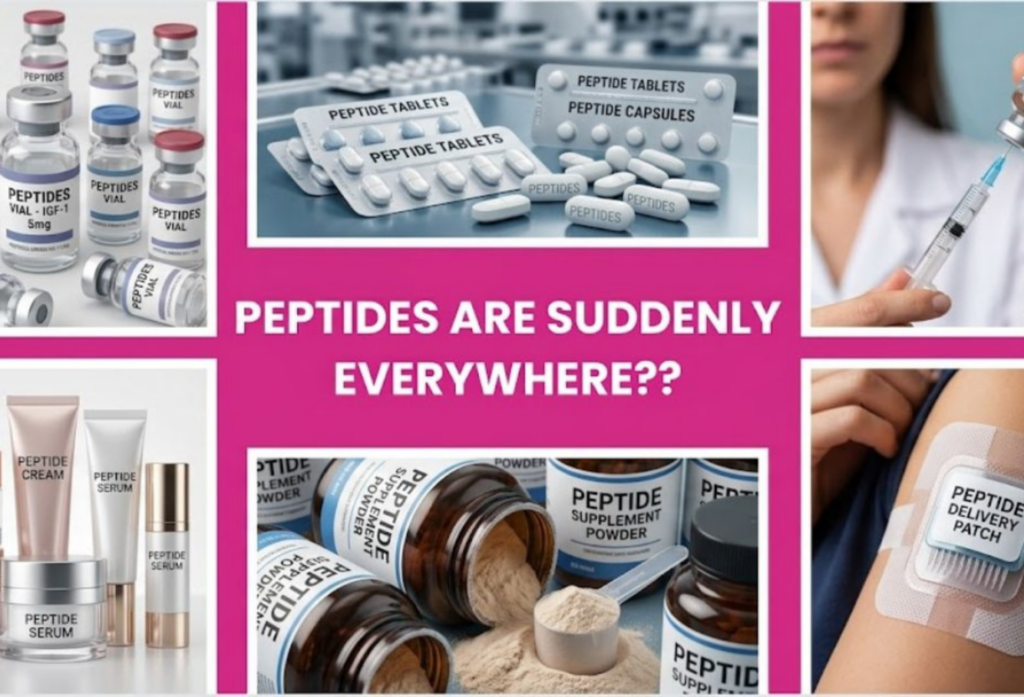
The Peptide Black Market Nobody Is Talking About
Here’s what I want you to picture.
The lady doing your nails? She might have peptides in her station drawer. Your hairstylist? Probably has a stash. The guy at your gym? He’s got a “hookup.” There’s a kingpin somewhere buying peptides in bulk with cryptocurrency, distributing them to Susie, who’s selling them to anyone who asks and leaving the vials in locker number seven.
I am not making this up. This is happening. At my gym. At gyms all over the country.
People are buying injectable compounds from strangers, mixing them at home, and injecting them into their bodies… because the wellness industry has made peptides sound like the answer to everything, and the healthcare system has made legitimate access either impossible or unaffordable.
I get it. I genuinely do. When your insurance stops covering your GLP-1 and you’ve been getting real results and you can’t afford $1,200 a month out of pocket… I understand why someone goes looking for another way. That desperation is real.
But here’s what the desperation is leading people into. And it is wild.
People Are Injecting Expensive Water. Literally.
This is the part that stopped me cold.
A guy who does business in China regularly (also a regular peptide user) decided to go directly to the manufacturer his U.S. pharmacy claimed was their supplier. He negotiated a deal. Got $8,000 worth of peptides for $1,000. Felt like a win.
Because he’s careful, he sent samples off for purity testing before using them.
The Retrutide? Nothing. Literally nothing. A powder that dissolved into water. A placebo he would have injected into his body thinking it was doing something.
The GHK-Cu copper peptide? Trace amounts at best…essentially worthless. Oh, and it also contained unidentified DNA.
And that’s someone who was being careful. Who tested before using. Most people don’t test. Most people just inject and hope.
According to recent data there has been an 88% decrease in purity testing of black market peptides. People aren’t asking what’s in them anymore. They’re just saying give it to me, and I’ll figure out the rest. But if you’re curious about regulatory guidelines, PubMed has them here.
In just the first three months of 2026, people spent $32 million on peptides via cryptocurrency alone…up 199% from the previous quarter. And that number is on track to surpass $100 million by summer. That’s only what can be tracked through crypto. It doesn’t count wire transfers, cash, or the locker-seven gym transactions.
Why Use Crypto for Peptides? Why Not Just Use a Credit Card?
This is the detail that tells you everything you need to know about the legitimacy of what’s being sold.
Credit card companies have categorized unregulated injectable peptides as “research chemicals.” Because they are not FDA approved for human use, selling them as such is illegal. So vendors can’t process normal payments. Banks won’t touch them. PayPal won’t touch them.
So they moved to crypto. And to wire transfers. And to gym locker drops.
When the financial system refuses to process a transaction… that is the financial system telling you something.
The FDA has not approved the vast majority of injectable peptides being sold right now for human use. That doesn’t automatically mean they’re dangerous. But it does mean there’s zero regulatory oversight of what’s actually in the vial you’re buying, what dose you’re getting, whether it’s sterile, or whether it contains anything at all.
Real Consequences. Actual People. Real Damage.
I want to share a few stories because I think we’ve been lulled into thinking this is low-risk because we haven’t heard dramatic headlines yet. But the damage is happening. It’s just quieter.
Story one.
A woman in a Facebook group posted that she had just accidentally injected herself with five times the recommended dose of a compound she’d ordered online, mixed herself, and dosed herself with based on a calculator someone sent her. She was shaking. Didn’t know if the shaking was anxiety or the overdose. Asked the internet what to do. The internet told her to expect vomiting so severe she’d end up hospitalized from dehydration.
She mixed and dosed this herself. There was no medical supervision, and no clue what was actually in what she’d put in her body.
Story two.
A nurse practitioner friend of mine recently saw a patient, a young woman in her 30s, and after she left, my friend turned to her colleague and said: “What happened to her voice?” This woman, who she described as beautiful and feminine, now speaks with the permanent deep rasp of someone who has smoked for decades. She had ordered testosterone online, without a prescription, without a physician, and accidentally dosed herself so high that she caused permanent, irreversible vocal cord changes.
Permanent. In her 30s.
Story three.
The Barbie peptide: melanotan II. It’s a peptide that triggers melanin production and makes you look tan. It’s all over TikTok right now. Influencers with instructions on how to reconstitute it at home, where to buy the insulin syringes at CVS, how to inject it yourself.
A dermatologist shared a case of her patient (someone who already had a history of abnormal moles) who took melanotan II for just two weeks. Research on melanocyte-stimulating hormones confirms what she found: the peptide stimulates the same cells that produce pigment, moles, and melanoma. Her patient developed nine new abnormal moles in fourteen days. Nine potential melanomas in two weeks from a peptide a 20-something TikTok bro was selling for crypto.
The Influencer Problem Is Making This Worse
I’ve been watching something shift in my community that genuinely bothers me.
Women I have followed for years, women my age, women I have respected, have quietly become peptide pushers. They’re promoting peptide products, peptide protocols, peptide stacks. And I know, because I’ve been approached too, that there is real money in it.
“Chalene, you take peptides. Why won’t you get on board?”
Because I’m not willing to tell you to inject something into your body that I cannot personally verify is safe, effective, dosed correctly, sterile, or even real. I’m not willing to do that for a commission. Full stop.
The fact that someone’s best friend lost 30 pounds on a peptide they bought from their nail salon’s “hookup” does not mean it was safe, legal, or even actually what it claimed to be. It might mean they got lucky. And we tend to only hear from the people who got lucky.
So What Actually Is Safe?
Here’s my honest answer, and I’m not going to dress it up: I don’t know what’s safe for you. Neither does the person selling peptides from their gym locker.
What I do know:
If you’re curious about peptide therapy (and there are legitimate reasons to be) the conversation starts with a physician who specializes in this area, not a TikTok influencer, not a friend of a friend, not a gray market website. My conversation with Dr. Elizabeth Yurth on YouTube goes deep on what legitimate peptide therapy actually looks like, what questions to ask, and what the real research says. Start there.
If you’re already using peptides from an unverified source, please stop and get bloodwork. Get a scan. Understand what’s already happening in your body before you continue taking something that stimulates growth factors. As I said on the podcast: things that stimulate growth don’t always pick and choose what they grow.
If a vendor requires crypto or wire transfer, that’s a red flag. The reason legitimate businesses can process credit cards is because they operate within regulatory frameworks. When payment processors refuse to touch a transaction, there’s a reason.
If you want to learn more about peptides from a grounded, medical perspective, I’ve covered this topic in depth before, including the two I personally take, why I take them with physician oversight, and why I still won’t recommend them to anyone else.
The Bottom Line on Peptides
Peptides might be one of the most promising areas in longevity medicine right now. The research on certain compounds, collagen synthesis, cellular repair, metabolic function, is genuinely interesting, and I believe there’s a real future here under proper medical supervision.
But right now? The market is the wild west. Products containing nothing. Containing unidentified DNA. Peptides causing permanent damage. Influencers cashing in. Scammers swarming. And a black market that just tracked $32 million in crypto transactions in three months and is still growing.
I’m not saying never. I’m saying not like this.
You deserve better information than you’re getting from TikTok. Find a doctor who takes this seriously to know what you’re actually putting in your body.
That’s all I want for you.
Love you. Mean it. xo
-Chalene
Frequently Asked Questions
Are peptides legal to buy?
Most injectable peptides being sold online are classified as research chemicals and are not FDA approved for human use. There are recent reclassifications from the FDA, outlined by Amanacia Health here. It is technically illegal to sell them for human consumption, which is why many vendors require cryptocurrency or wire transfers…payment processors and banks won’t process these transactions.
Are peptides safe?
Under legitimate physician supervision, with verified compounding pharmacies, certain peptides have promising research behind them. The danger lies in unregulated black market products with no purity testing, no sterility standards, and no accurate dosing information, which is the majority of what’s currently being sold online.
What are fake peptides?
Fake peptides are products sold as active peptide compounds that contain little to nothing when tested for purity. Recent data shows an 88% drop in purity testing among black market products, and multiple independent tests have found vials containing nothing but water or unidentified DNA.
What is melanotan (AKA the Barbie peptide)?
Melanotan II is an injectable peptide sold online as a self-tanning agent. It stimulates melanin-producing cells, the same cells responsible for moles and melanoma. Studies show even short-term use can trigger abnormal mole growth, particularly in people with a predisposition to skin cancer. It is not FDA approved.
How do I find a legitimate peptide provider?
Start with a physician who specializes in longevity or integrative medicine. Any reputable provider will require bloodwork and a medical consultation before prescribing anything, use licensed compounding pharmacies, and provide third-party purity verification. If someone is selling to you through social media, crypto, or a gym locker…that’s not it.
🎙️ Listen to the full scoop on The Chalene Show: Episode 1304
📺 Watch some of my conversations about peptide therapy: