
Bone Health After 40: Should You Wear a Weighted Vest?
Every year, millions of women over 50 break a bone doing something as ordinary as stepping off a curb. And one in three who fracture a hip? They don’t make it past the next year. Sobering, right?
That’s why bone health has become one of the hottest conversations in midlife. And at the center of it all? Not some fancy supplement or pricey procedure… but a weighted vest. Yep, that bulky thing people are strapping on for walks, workouts—even trips to the grocery store.
The question is: do weighted vests really help protect your bones, or is this just another wellness trend gone viral?
Table of Contents
ToggleMy Wake-Up Call
In my late 40s, perimenopause hit me like a surprise party nobody asked for: sleepless nights, thinning hair, and fat showing up in places it had never RSVP’d before. My doctor ordered a DEXA scan, and I was positive I’d crush it. I mean, hello—I lift heavy, I eat clean, and I’ve built a career around fitness.
Plot twist: the scan came back with osteopenia.
So I got serious. I added vitamin D, magnesium, calcium, more intentional skeletal loading, and yep—a weighted vest. Fast-forward a few years, my DEXA improved. Naturally, I gave credit to “all the things,” vest included.
Then came the Instagram comments. Normally, I scroll right past the haters and the Negative Nancys. But this time, I noticed a pattern: “Weighted vests don’t help bone density.” And not just one person…several.
Instead of hitting delete, I thought, “Okay… is this just trolling, or is there something here?” So I went back to the research to find out if weighted vests really deserve the hype, or if I’d been influenced right along with everyone else.
But First: What is a DEXA Scan (and Why It Matters)
When my doctor first suggested a DEXA scan, I honestly thought, “Cool, another random test I probably don’t need.” But here’s the deal: this scan is like pulling back the curtain on your body.
DEXA = Dual-energy X-ray Absorptiometry. Don’t worry about pronouncing it. What matters is what it shows you:
- Bone density: (your fracture risk). Are your bones strong, or are they inching toward osteoporosis?
- Body composition (fat vs. lean mass). How much of you is fat, lean muscle, and bone.
Think of it like the receipts. No guessing. No “I feel strong, so I must be fine.” A DEXA gives you an actual baseline, so you know if all your lifting, eating clean, and supplementing is really paying off—or if you’re headed for trouble.
And let me tell you, nothing humbles you faster than getting a scan that says: hey, your bones aren’t as tough as you thought.
How Weighted Vests Got So Popular
Weighted vests didn’t come out of nowhere. Their roots go back to the military—soldiers carrying insanely heavy packs in training (“rucking”). Trainers eventually realized all that extra weight built toughness, strength, and endurance.
Fast-forward to the 90s and 2000s: osteoporosis was becoming a massive women’s health concern. Researchers started asking: what if we use that same principle—extra load—to keep bones strong? Enter: the weighted vest trend.
What the Studies Actually Show
- 2000: Postmenopausal women wore vests while doing high-impact jumping with progressive overload three times per week. Result: hip BMD held steady vs. 3–4% loss in controls. Key detail often lost: it wasn’t “just wear a vest,”it was impact + progression.
- 2017: Calorie restriction + passive vest wear in older adults. Result: bone changes statistically insignificant.
- 2020: Passive, all-day vest wearing without impact training. Result: at best a tiny, statistically weak trend.
A JAMA, INVEST trial tested three groups during weight loss:
- The first was diet only
- Then diet + daily passive vest (up to ~7 hours)
- And the last was diet + resistance training (no vest).
Result after 12 months: all lost bone; only resistance training meaningfully reduced bone loss. The vest didn’t move the needle by itself.
Bottom line: A weighted vest with impact and progressive overload (jumping, hopping, structured training) can help preserve bone at specific sites. But just strapping one on and walking around? That’s not a bone-building strategy.
Here's what you need to know before you click “add to cart.”

A Bone Surgeon Weighs In
I asked Dr. Vonda Wright, author of “Unbreakable,” to cut through the noise. Her rapid-fire take:
- Weighted vest vs. giving up alcohol—for bones? Give up alcohol.
- Daily walking vs. high-impact a few times a week? High-impact wins for bone.
- Lifting weights vs. yoga/Pilates—for bone? Lifting, every time.
- Vitamin D from sun vs. supplement? Most need a supplement to reach adequate levels.
- Passive vest wearing for bone? “The studies are small and underpowered. Don’t prioritize a vest to build bone. It’s not bad, but it can't be your number one or only strategy.”
- Who should be cautious? Women with spine osteoporosis or significant thoracic kyphosis. Don’t axial-load a fragile spine. Consider waist-level loading instead of weight across the shoulders.
- Back issues/SI pain? Skip loading the thoracic/lumbar spine; explore belt/waist loading options.
- How heavy? If you use one, many protocols start at ~10% of body weight, but strength matters more than scale weight. Progress gradually.
So…Should You Wear a Weighted Vest?
Short answer: yes—if you like it. But be crystal clear about what it actually does (and doesn’t) do.
No—if you expect it alone to improve bone density. For bone, the stimulus must be specific and progressive (jumping/impact or heavy loading at the target sites).
Why You Might Love It
- Makes your walks or hikes feel like a workout without cranking the treadmill incline to “Everest.”
- Gets your heart rate up into zone 2 cardio faster (without pounding your joints).
- Helps with posture and balance—two huge factors for preventing falls as we age.
- Adds a little extra challenge to cardio or even certain strength moves if you want to spice things up.
Why It’s Not a Magic Bullet
If you’re banking on a vest alone to fix bone density, you’re going to be disappointed. Bone responds to impact and heavy loading. That means lifting weights or doing actual jumping/impact moves—not just wearing extra pounds on your shoulders while folding laundry.
What Actually Moves the Needle for Midlife Bone Health
Here’s the truth: there’s no magic bullet for bone health. What works is a stack: layering proven strategies together. Think of it like building a playlist…one song isn’t the vibe, but stack them right and suddenly it’s fire.
Here’s your bone-strong stack:
- Lift heavy, 2–4x per week. Focus on hips and spine with big compound moves (squats, deadlifts, presses). That’s where fractures usually happen,
- .
- Add impact—if your body allows. Short bouts of jumps, hops, or plyo 2–3x per week can stimulate bone. Keep it short and quality over quantity.
- Protein, protein, protein. You need enough daily to build and preserve muscle, which directly supports your bones.
- Vitamin D + calcium. Don’t just nibble on a little spinach and call it good. Get tested, supplement if needed, and make sure your total intake is solid.
- Cut the bone killers. Smoking, excess alcohol, crash diets, and sitting all day accelerate bone loss.
- Train your balance. This prevents falls in the first place. Weighted vests can help here, but so can yoga, single-leg moves, or even walking on uneven terrain.
- Check your hormones. If you’re in perimenopause or menopause, a qualified clinician can help you look at hormone replacement as part of the plan.
If You Do Use a Vest: Smart Guidelines
Alright, if you’re gonna rock the vest, here’s how to do it without wrecking your back or quitting after two minutes because it feels awful:
- Start light. Around 10% of your body weight is the usual rule. You can always add more later—progression is the name of the game.
- Use it where it makes sense. Think incline walking, hiking, or layering it into some strength sessions. It’s about boosting the workload, not punishing your body.
- Comfort is non-negotiable. If it’s digging into your shoulders or sliding around, you won’t wear it. Look for a secure, snug fit that actually feels good.
- Check your spine health first. If you’ve got osteoporosis, kyphosis, or back issues, don’t just throw weight across your shoulders. Talk to your clinician and consider a waist or belt-style option that loads your hips instead.
Bottom line? The right vest should feel like an upgrade, not a punishment. If it’s miserable, you’re doing it wrong—or you bought the wrong vest.
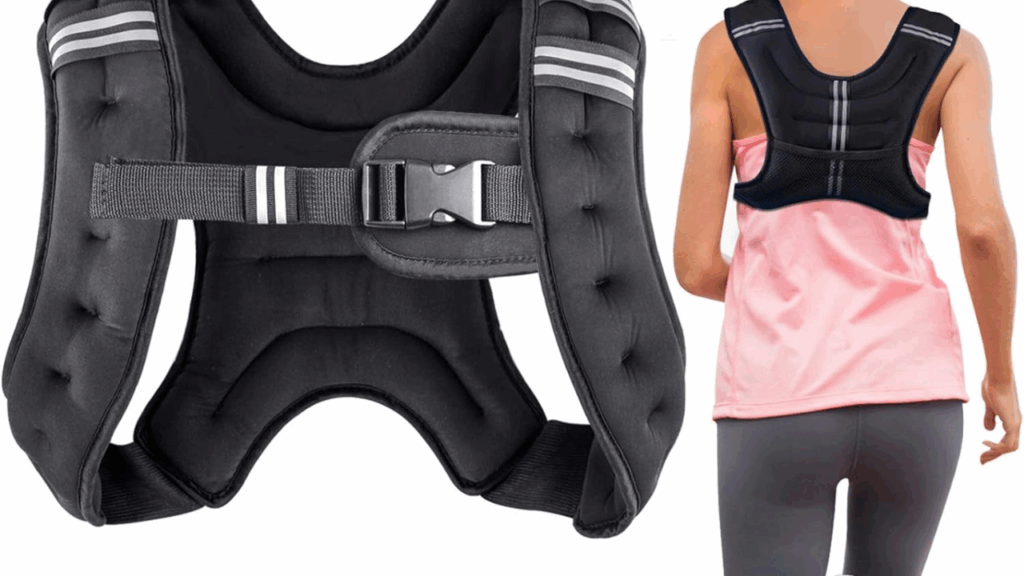
Here are my top choices:
The Bigger Lesson
I’ve been “influenced,” too. Repetition turns into “truth” fast online. The vest isn’t useless—but it isn’t the fix. It’s a tool. Use it for what it’s good at, and build your bone plan on the foundations that actually change bone: heavy resistance, impact, protein, micronutrients, balance, and smart lifestyle choices.
Am I still going to wear my weighted vest? Yes—for conditioning and balance. But for bone density, I’m doubling down on the real levers and using the vest as an accessory, not the main event.