Your Brain Makes Its Own Estrogen. Here's Why That Changes Everything About Menopause
I stumbled onto a study last month that genuinely stopped me in my tracks. Not because it was alarming, although parts of it are, but because it reframed something I thought I already understood. I've been talking about hormones for years. I went through perimenopause. I've had the labs done and worked with dozens of clinicians. And I still had no idea about this.
Your brain makes its own estrogen. Completely separate from your ovaries. And when perimenopause hits, that estrogen declines too.
If you've been brushing off your brain fog as getting older, or telling your doctor you don't really have symptoms, or wondering why you walked into a room and genuinely cannot remember why you're there, this new research on estrogen and brain fog in menopause is worth a few minutes of your time.
The Brain Estrogen Discovery Nobody Is Talking About
A study published in May 2026 in The Aging Cell journal, conducted by Northwestern Medicine, confirmed something that most women, and most doctors, have never been taught: the hippocampus, the part of your brain responsible for forming and storing memories, produces estrogen entirely on its own.
This is not estrogen traveling up from your ovaries. This is estrogen manufactured locally, inside the brain itself, for the brain's own purposes.
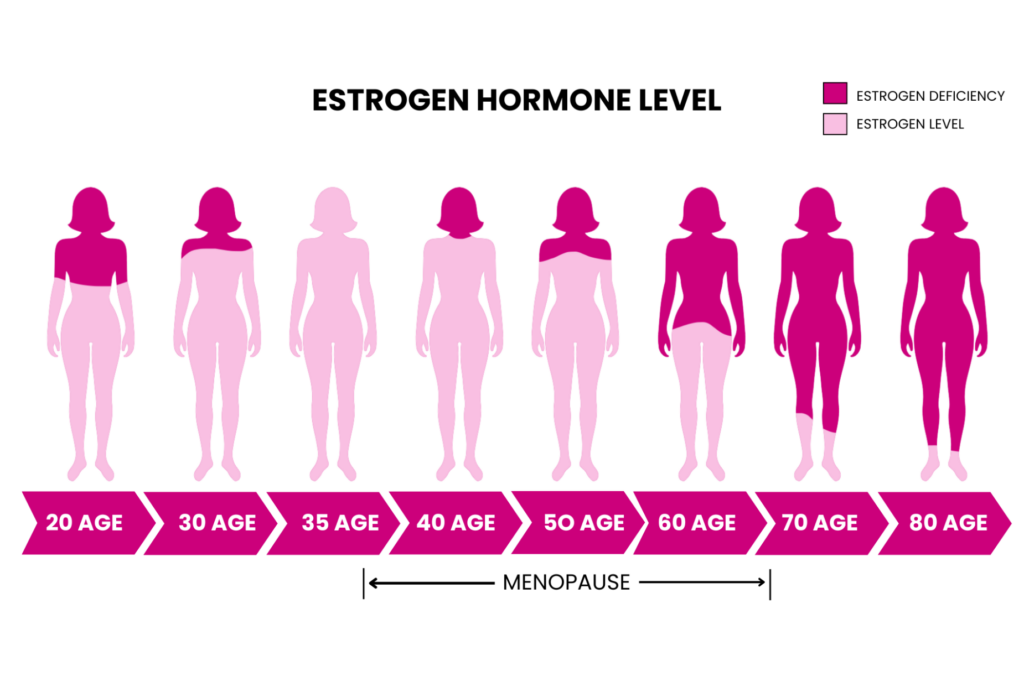
Men produce it too. But here's where it gets relevant to every woman reading this. When perimenopause begins, and that can start as early as your mid-thirties for some women, two things happen at roughly the same time. Ovarian estrogen begins to decline, which is the part we've always talked about. And estrogen production inside the brain begins to decline at approximately the same rate.
That second part is the part nobody has been discussing. And based on what researchers are now seeing, it may matter enormously.
What the Hippocampus Has to Do With Your Memory
The hippocampus is the brain's memory center. It's where new memories are formed, where experiences get encoded, and where your ability to learn and retain information lives. It is also, as this Northwestern study confirmed, an active producer of estrogen, not a passive recipient of whatever the ovaries happen to send its way.
That distinction matters because it means that even if you are on hormone replacement therapy and replacing ovarian estrogen, you may not be fully addressing what's happening at the level of the brain's own estrogen production. The research on that piece is still early. But the mechanism itself is now confirmed.
What researchers found is that when estrogen production in the hippocampus declines, something structural begins to change inside the brain. Not in a vague, hard-to-measure way. In a specific, observable, physical way.
The Structural Scaffolding Explanation That Will Stay With You
This is the part that has been sitting with me since I read the study. When local estrogen production in the hippocampus declines, it damages what the researchers describe as the structural scaffolding of the brain. This is the matrix that holds brain cells in the correct position to communicate with each other, to pass information back and forth, to form and reinforce memories.
When that scaffolding is compromised, the brain cells are still there. But their ability to talk to each other, to build and hold memories, is impaired.
One of the Northwestern researchers described it this way: “The hippocampus is not just a passive recipient of estrogen from the ovaries. It is an active producer, and when local production is disrupted, the structural integrity of our memory circuit is compromised in ways that we are only beginning to understand.”
The structural integrity of our memory circuit.
That phrase is not about aging gracefully or accepting that your recall gets a little slower after 40. That is a description of a physical mechanism inside your brain being disrupted by a hormonal shift that most women are experiencing right now without any framework to understand what is actually happening.
Why This May Connect to Alzheimer's in Women
Approximately two-thirds of all Alzheimer's cases occur in women. That statistic has been sitting out there for years without a satisfying explanation. Researchers have pointed to women living longer, to differences in how the female brain ages, to various genetic and lifestyle factors.
This Northwestern research adds a new piece to that puzzle. If estrogen is actively produced in the hippocampus and plays a structural role in memory circuit integrity, and if women experience a more dramatic and rapid decline in that estrogen during menopause than men do during their more gradual hormonal shifts, that differential could help explain why women are disproportionately affected by Alzheimer's.
The clinical trials examining this connection are in very early stages. This is not a definitive answer. But it is a direction of research that feels overdue, and it reframes the entire conversation about what menopause is actually doing to the female brain.
Brain Fog Isn't You Getting Old and Forgetful
This is the part I need you to hear, gorgeous, because I've said versions of this before but the science now gives it a different weight.
When you walk into a room and forget why you're there, when a word you've used a thousand times suddenly won't come when you need it, when you read the same paragraph three times and still can't retain it, when you feel like your brain is running through mud, that is not you becoming forgetful. That is not a personality flaw or a sign that you're not sharp enough or that you've let your mind go.
It's the structural scaffolding of your memory circuit being affected by a decline in a hormone your brain was actively producing and now is producing less of. An actual biological mechanism with a name and a location and an emerging body of research. This leads to general burnout for so many women.
The way I think about this now is that we've been having the wrong menopause conversation for decades. Night sweats, hot flashes, dry skin. Those are real and they deserve attention. But they're not the whole picture. The brain piece, the memory piece, the estrogen-and-brain-fog-in-menopause piece, that needed to be part of this conversation a long time ago.
Why I Told My Doctors I Had No Symptoms (And I Was Wrong)
I want to be honest with you about something, because I think a lot of you are doing exactly what I did.
Out of roughly ten doctor's visits during my perimenopause years, I told them I had no symptoms at least eight times. Not because I was lying. Because I genuinely did not connect what I was experiencing to perimenopause. The symptoms I was having weren't consistent. Some weeks they were there, some weeks they weren't. I would have fill-in-the-blank symptom for a little while and then it would seem to go away, and I'd tell myself it was because I hadn't been sleeping well or I was stressed or whatever else felt logical at the time.
It wasn't until I got my labs drawn and sat with an integrative doctor who showed me how low my hormone levels actually were that I started to connect the dots. My cortisol was high. Multiple hormones were low. And suddenly, in hindsight, the things I had been dismissing as unrelated started to make a lot of sense.
Brain fog is not a dramatic symptom for most women. It comes on slowly. From one day to the next you don't notice the change. That's exactly why it gets dismissed, by us and sometimes by the clinicians we see.
My honest recommendation, girlfriend to girlfriend, is to work with a clinician who looks at both your labs and your symptoms.
I use and genuinely recommend MIDI Health for hormone-related care. It's a virtual practice built by women who went through this themselves, staffed by clinicians whose entire focus is women's hormonal health, and covered by most major insurance. You can book at chalene.com/midi.
What This Means for How We Think About HRT
This research does not mean that hormone replacement therapy will prevent Alzheimer's or fully reverse the effects of declining brain estrogen. That is not what the current data shows, and anyone telling you otherwise is getting ahead of the science.
What it does mean is that the conversation around HRT needs to expand beyond skin, sleep, hot flashes, and libido. The brain is in this conversation now, and with real biological mechanisms to point to, not just observational associations.
If you have been on the fence about addressing your hormones because you don't feel like your symptoms are bad enough, or because you don't want to take medications unnecessarily, I understand that. I want you to make an informed decision, not a fear-based one. But I also want you to have all the information. And the information now includes the fact that estrogen is structural to your memory circuit, that its decline in your brain is real, and that the window for intervention may matter.
The clinical trials are underway. The conversation is changing. And you deserve to be in it early, not five years from now when the research is fully mature and the recommendations have trickled down to every general practitioner.
FAQ
Does your brain actually produce its own estrogen?
Yes. The Northwestern Medicine study published in May 2026 in The Aging Cell confirmed that the hippocampus, the brain's memory center, produces estrogen independently of the ovaries. This was not widely known before this research and changes how researchers understand the relationship between menopause and cognitive health.
Why does estrogen matter for memory and brain health?
According to the Northwestern research, estrogen produced locally in the hippocampus plays a structural role in maintaining the scaffolding that allows brain cells to communicate with each other and form memories. When that local production declines, the structural integrity of the memory circuit is affected.
Is there a connection between menopause and Alzheimer's?
Researchers are actively investigating this. Approximately two-thirds of Alzheimer's cases occur in women, and the discovery that the brain's own estrogen production declines during menopause offers a potential biological mechanism that may help explain this disparity. Clinical trials are in early stages.
What are the signs that brain fog might be perimenopause-related?
Walking into rooms and forgetting why, struggling to retrieve words you know well, difficulty concentrating, feeling like your thinking is slower or less sharp. These symptoms often come on gradually, which is why many women don't connect them to perimenopause. If they are new or worsening, they are worth discussing with a clinician alongside a full hormone panel.
Should I start HRT specifically for brain health?
This is a conversation to have with a qualified clinician who knows your full health history. The research on brain estrogen is new and the clinical trials are early. What is clear is that the brain is now part of the menopause conversation in a meaningful way, and that addressing hormonal decline earlier rather than later appears to have broader benefits than previously understood.
Listen to the Full Episode
I cover this study in detail in Episode 1307 of The Chalene Show, including the researcher's exact quote that I cannot stop thinking about. Send it to any woman in your life who keeps dismissing her brain fog as just getting older.
Love you, mean it.
Chalene
P.S. If your labs look normal but you feel like you're losing your mind, keep pushing your clinician. If you feel fine but your labs show significant decline, take that seriously before the symptoms arrive. The brain research now gives us even more reason not to wait.
Comment below about your experience with this! I wanna hear from you!