The Hormone Factor (And Why Midlife Burnout in Women Starts Here)
Let’s start here because yes, hormones are involved. And no, it’s not just night sweats.
Estrogen and progesterone don’t just govern reproduction. They regulate your neurotransmitters, your mood, your stress response, and your sleep. When those hormones start fluctuating in perimenopause, they’re not declining steadily in a predictable way. They’re lurching. Good for four days, terrible for six. Symptoms that appear, disappear, and come back differently. It’s like trying to drive a car while someone randomly jerks the wheel.
That unpredictability is what makes perimenopause so mentally destabilizing. Many women don’t even realize that’s what’s happening. They just think something is wrong with them. The panic attacks, the mood swings, the brain fog, the irritability… these aren’t personality changes. They’re neurological events tied directly to hormonal shifts.
And here’s something that does not get said enough. A 2025 systematic review by Hendriks and colleagues, published in Women’s Health, reviewed 19 studies on menopause and mental health. Sixteen of those 19 found a strong association between the menopausal transition and increased suicidality, with 7 studies specifically noting the elevated risk in perimenopausal women. The highest-risk window was perimenopause. If you’ve had moments where you’ve felt like you don’t care anymore, like you’ve stopped making the bed, stopped going to the gym, just wanting everyone to leave you alone… please don’t dismiss that. That’s not laziness. That can be a sign your hormones need support and that you need more help than you’re currently getting.
The earlier you address hormonal decline, the better the outcome for your long-term brain health, your skin, your sleep, your weight, all of it. If you’ve been putting off that conversation with a doctor, stop waiting. I personally use MIDI Health for my hormone care. It’s a virtual practice built specifically for women navigating this transition, covered by most major insurance, and staffed by clinicians whose entire focus is this.
Full disclosure: I am a paid partner with Midi Health. I’ve looked around, tried other telehealth, and they’re hands down my fav. Go wherever you’re most comfortable!
The Sandwich Generation Is Real and It’s Crushing Us
At the same time your hormones are doing their thing, many of you are also carrying your kids, your parents, your household, your career, and your friendships on your back simultaneously. Researchers call this the sandwich generation, and the data is sobering.
A 2025 report from the University of Phoenix Career Institute and Motherly found that 64% of sandwich generation working moms use their sick time and PTO on caregiving, 58% have turned down educational opportunities because of caregiving responsibilities, and 46% say their caregiving has held their career back. Half have left a job entirely because of it.
And the load is heavier than it used to be because our adult kids are staying dependent longer than any previous generation. They’re moving out seven years later. Getting their licenses later. Carrying more anxiety, more financial stress, and more emotional complexity than we did at their age. So we’re trying to help them navigate all of that while simultaneously making medical decisions for aging parents. On top of managing our own lives. While trying to stay physically healthy…while not sleeping…while pretending it’s fine.
We just deal with it. That’s what our generation does. Walking pneumonia? Keep moving. Exhausted? Power through. “If I don’t do it, it doesn’t get done.” That story has cost a lot of us more than we realize.
AI, Job Anxiety, and the Story We Were Told That Isn’t True Anymore
Here’s the one that’s sneaking up on people. You might not be consciously thinking about AI every day, but the uncertainty is sitting in the background, quietly adding to the load.
A March 2026 national survey from Jobs for the Future found that in a marked shift from just a year prior, workers are now more likely to say AI is a net-negative than a net-positive when it comes to finding jobs, building wealth, and protecting their quality of life. Optimism about AI’s impact on workers dropped 10 percentage points in a single year.
We don’t have a date or a timeline. We just have this low hum of “the skills I spent decades building might have an expiration date” sitting in the back of our minds. Every conversation about AI, every headline about layoffs, every kid who just graduated and can’t find a job… it adds water to the bucket.
The story we were raised on was: work hard, build expertise, stay valuable, and you’ll be safe. That story is no longer reliable. And if you’re not feeling anxious about that, you might be wondering if you should be. Either way, it’s one more thing.
Digital Overload Is Physically Exhausting Your Brain
This one is not getting enough attention, and it’s one of the biggest drivers of midlife burnout in women that nobody’s naming correctly.
The exhaustion you feel at the end of a day where you “didn’t do anything” is real, and it has a physical explanation. Every notification your brain processes requires a decision. Every decision requires adenosine triphosphate, actual cellular energy. Your brain is burning fuel on every ding, every headline, every context switch. When you go from a work email to a text from your kid to a call from your dad to a social media scroll, you are switching roles, communication styles, emotional registers, and cognitive frameworks in seconds, over and over all day long.
That is not metaphorically exhausting. It is physically exhausting. Research consistently links digital multitasking to increased fatigue, heightened anxiety, and cortisol dysregulation. And then we wonder why we don’t have the energy to work out, connect with friends, or even wash our faces at the end of the day.
Your grandmother had two ways to communicate: the phone and in person. We have ten platforms with different rules, different interfaces, different notification sounds, and different expectations about response time. Add to that the content flooding every ‘For You’ page, designed to trigger comparison, present impossible choices, and make you feel perpetually behind. Psychologists have consistently shown that more options don’t feel empowering. They create anxiety, regret, and decision fatigue because every choice means rejecting another one.
The Body Image Trap Has Never Been More Relentless
When I asked women in my community what was stressing them most about midlife, the number one answer was body image and appearance.
The cruelty of the timing is real. At the exact moment your body is changing in ways you didn’t fully anticipate (weight redistribution, muscle loss, skin texture changes, hair thinning) you are also being flooded with messaging about how you’re supposed to handle it. Fight aging. Get a facelift. Accept aging. Age gracefully. Optimize aging. Reverse aging. Every direction at once, and every choice you make gets read as a statement about who you are.
Get Botox and you hate yourself. Don’t get Botox and you’ve let yourself go. Take a GLP-1 and you’re cheating. Don’t take it and you’ve given up. Use peptides and you’re vain. Don’t use them and you’ve stopped trying. There is no winning position, and social media ensures that whatever you decide, someone is ready to tell you that you got it wrong.
The goal can’t be finding the answer that makes everyone happy. The goal has to be making informed choices and refusing to let a comment section have authority over your self-worth. That’s easier said than done. It starts with recognizing the game for what it is.
The Loneliness Nobody Talks About
Friendships shift in midlife. Divorce, distance, new life stages, better boundaries, less time. And even when people are around, digital connection does not feel the same as in-person connection. It doesn’t activate the same nervous system responses. It doesn’t create the same sense of safety.
So many women right now are carrying everything described in this post privately. They feel guilty naming it. They don’t want to burden anyone. They’re not connected enough to reach out, and the exhaustion makes it harder to change that. We don’t complain. We just keep going. And then we feel completely alone in it, even when millions of women are going through the exact same thing at the exact same time.
This is one of the reasons I created Camp Be More. Women need to be in the same room, looking at each other’s faces, saying “actually, no, I’m not okay” and having someone say “I know. Me neither.” That kind of connection cannot be replicated in a DM.
Your Nervous System Isn’t Broken. It’s Overloaded.
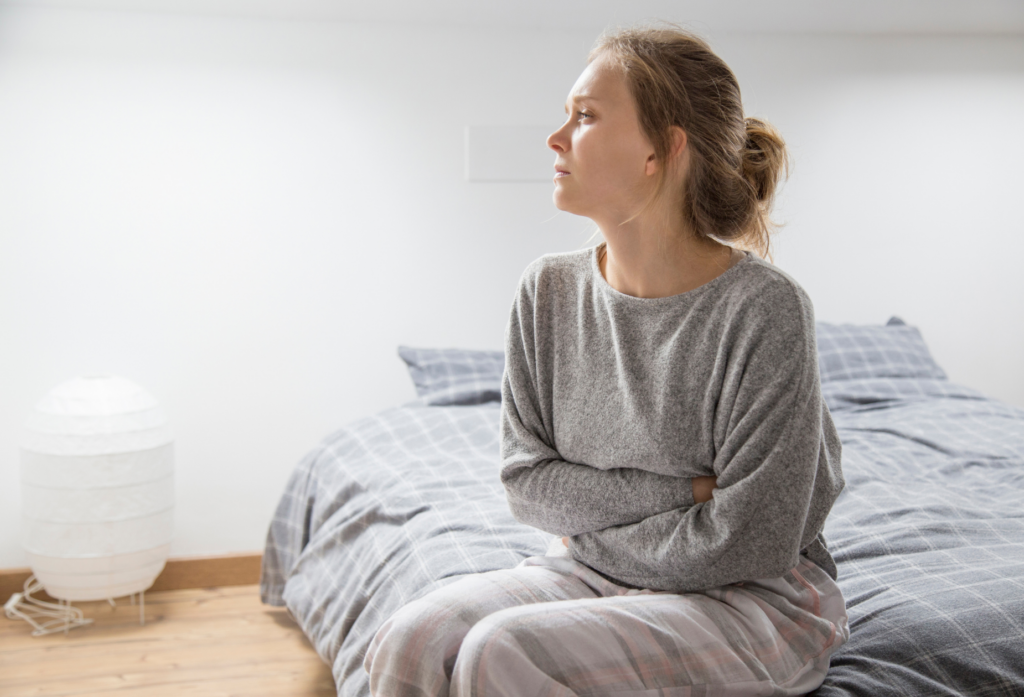
Think of your nervous system as a bucket. Hormonal fluctuation adds water. Sleep disruption adds more. Caregiving, financial stress, AI anxiety, digital overload, body image pressure, loneliness… every single one pours in more.
At some point the question stops being “why am I overwhelmed” and starts being “how could I not be overwhelmed.”
This is not you failing to cope. This is an objectively enormous load. The research backs that up. A 2026 analysis from the University of Phoenix found that 64% of sandwich generation working women are now at high risk of burnout, and nearly half a million women exited the U.S. workforce in just the first half of 2025 due to rising caregiving demands. You are not imagining this. The data confirms it.
What Actually Helps
Not optimizing harder. No new supplement stack. Definitely not a tighter schedule.
What actually helps is pulling back. Auditing where you’re spending energy and asking honestly: do I actually have to do this? Am I really responsible for this person’s experience? Is this obligation real or something I put on myself?
Start with sleep and protect it aggressively. Reduce your decision inputs. Get off short-form social media, or at minimum, limit it deliberately. Find one person, in person, who gets it, and say something true to them.
If you’ve been feeling empty, numb, or not like yourself, please talk to someone. A therapist. A doctor who actually listens. Both.
Your reactions make more sense than you’ve been led to believe. You are not too sensitive, dramatic. or lack discipline. You need permission to put some of this down.
FAQ
What is midlife burnout in women and how is it different from regular burnout? Midlife burnout in women typically involves a convergence of factors happening at the same time: hormonal changes that directly affect brain chemistry and stress regulation, increased caregiving demands from multiple generations, shifting identity, and greater economic uncertainty. It’s not just work stress. It’s a full-system load hitting from multiple directions simultaneously, which is why it’s so hard to locate a single cause.
How do I know if my exhaustion is hormonal or something else? Honestly, it’s often both. Hormonal fluctuation in perimenopause directly affects sleep, mood, and energy, but digital overload, caregiving stress, and identity pressure all compound the same symptoms. The most useful move is to get your hormone levels assessed by a clinician who specializes in this, and take an honest look at your total load at the same time. One doesn’t cancel out the other.
I feel like I should be able to handle this better. Is something wrong with me? Nothing is wrong with you. The research is clear that midlife women right now are carrying an objectively heavier load than previous generations, compounded by hormonal changes that affect the brain’s ability to regulate stress. Struggling under that weight is not a character flaw. It is a rational response to an irrational amount of pressure.
What’s the first thing I should actually do? Tell one person the truth. Not a highlight reel, not a vague “I’m tired,” but an honest account of what’s actually going on. Then make an appointment with a doctor who takes hormonal health seriously. Those two things won’t fix everything, but they interrupt the isolation and the silence, which is where a lot of the suffering lives.
Listen to the Full Episode
This is one of those episodes I had to record. If any part of this resonated, forward it to someone who needs to hear it. Sometimes the most important thing you can do is let a woman know she is not alone in this.
Catch episode 1305 of The Chalene Show here.
Love you, mean it. Chalene.