GLP-1s and Muscle Loss: The Activity Data That Changes the Conversation
Here is something I want every woman who is currently on a GLP-1 to read, and every woman who is considering one.
We have been talking about GLP-1 and muscle loss for a while now. The conversation has mostly centered on whether the medication itself is causing the muscle to disappear. The answer to that, as I have said many times, is no. The drug is not eating your muscle. The behaviors that come with it are. Not eating enough. Not strength training. A combination of both.
But now we have real-world data, not a controlled clinical trial, not a pharmaceutical-funded study, but actual Fitbit and Apple Health tracker data, and it tells a story that I think we have to take seriously.
What the Real-World Activity Data Actually Shows
Research presented at a major endocrinology conference in June 2026 used real-world data from fitness trackers to look at what actually happens to GLP-1 users’ movement patterns after they start the medication. Not what they reported in surveys. What their devices recorded.
The findings: after starting a GLP-1, users experienced measurable drops in daily step count and in moderate to vigorous physical activity, even as their weight was declining.
That last part is the piece that surprised even the researchers. When weight goes down without medication, movement typically goes up. People feel physically lighter, have less joint pain, feel more motivated to be active. We have always assumed that was the natural trajectory of weight loss. GLP-1s appear to reverse that pattern. Weight goes down, movement goes down with it.
One researcher presenting the data said: “We expected to see some reduction in activity given weight loss and calorie restriction. We did not expect this magnitude of drop, or the fact that it occurred even in users who had previously been highly active.”
Previously highly active. That is not sedentary people becoming sedentary. That is people who were already moving, already exercising, already motivated, losing that motivation after starting the medication.
The Neurological Shift Nobody Warned Us About
Here is the working theory from the researchers, and I want to be honest that this is still a theory, but it lines up with what a lot of women have been describing to me in my DMs.
GLP-1 receptors are not only in the gut. They are also in the brain. The mechanism that reduces hunger and quiets food noise appears to also reduce what researchers are calling the motivational drive more broadly. Not just the motivation to eat or drink alcohol or shop, but the motivation to move.
The researchers described it as a neurological shift in motivation. A drug that affects not just your capacity to move, but your desire to.
If you have been on a GLP-1 and noticed that you just don’t feel like working out the way you used to, that the gym feels less compelling, that you are getting fewer steps without quite knowing why, this may be the explanation. I want you to hear it clearly: this is not you becoming lazy. This is a documented effect that showed up in people who were previously highly active. It is worth being aware of and worth actively countering.
Why This Matters More for Women Over 40
Let me connect the dots here because I think this is where the stakes get real.
As weight goes down, some muscle loss is normal. We know this. As weight goes down, bone density can also decrease because the bones no longer have to carry as much load and do not need to be as dense. We know this too. The way to counteract both is movement, specifically strength training with progressive overload.
Now we have data suggesting that GLP-1 medications reduce the motivation to do exactly that. So weight is dropping. Muscle is dropping. Bone density is potentially dropping. And the primary counterbalance, consistent resistance training, is becoming harder to feel motivated to do because the same neurological mechanism driving weight loss is also dampening the drive to exercise.
A 2024 systematic review and network meta-analysis found that the highest doses of semaglutide and tirzepatide maximized fat loss but were the least effective at preserving lean mass. Add reduced activity on top of that and the picture becomes clearer about why muscle loss is such a consistent concern across the GLP-1 user population.
My big sister bossy recommendation: get a DEXA scan or an InBody composition scan before you start a GLP-1 and at regular intervals while you are on it. Many gyms and clinics have InBody scales. They are not as precise as a DEXA scan but they give you a directional baseline. You need to know whether your muscle mass is going up or down. The mirror cannot tell you that and neither can the scale.
The Stanford Muscle Compound: What We Know So Far
Here is the piece of this story I actually find genuinely hopeful, and I want to give it the context it deserves without overselling it.
Stanford Medicine published research in June 2026 in the Proceedings of the National Academy of Sciences identifying a companion compound that shows early promise in addressing muscle loss in GLP-1 users. This compound was originally being studied for age-related muscle loss, also called sarcopenia, and was already in clinical trials for that application.
In GLP-1 research, scientists have confirmed that both lean and fat mass are reduced during treatment, prompting investigation into compounds that could preserve lean mass without impacting fat loss outcomes. The Stanford compound appears to do exactly that in early research: when combined with a GLP-1, it enhanced muscle recovery and preservation without affecting the fat loss results. The fat loss stayed intact. The muscle wasting decreased.
That is meaningful. Not because it gives anyone a green light to skip the gym, but because it suggests the pharmaceutical space is actively working on this problem and taking the muscle loss concern seriously enough to fund real research.
A few things I want you to hold onto while you process this:
This is early data. Animal studies and early clinical trials are promising, but they are not the same as long-term human outcomes. This compound does not replace strength training. Even if something slows muscle loss, you are still losing muscle with age and with inactivity, medication or not. And this is not a reason to feel safer taking a GLP-1 without addressing the behavioral variables first.
What it does tell us is that the conversation is evolving, the research is catching up, and we will likely have better tools in the next few years for managing body composition during significant weight loss. That is genuinely good news for the millions of women currently navigating this.
What I Would Do If I Were Starting a GLP-1 Right Now
I am not your doctor. But here is where I land.
Before starting: get labs, get a body composition baseline, have an honest conversation with a clinician who will look at your hormones, your bone density risk, your strength training history, and your relationship with food, not just your BMI. (My go to is Midi Health). Full disclosure. I’m a paid partner with Midi Health. They’re one of the few reputable telehealth services out there advocating for women. I use em and love em!
While on it: treat strength training as non-negotiable, not optional. Understand that the motivation to exercise may feel different or diminished, and plan for that proactively. Track your steps. Notice if your movement is dropping and course-correct intentionally. The Endocrine Society states that behavior modification along with a GLP shows signs of better weight loss. And isn’t that what we want? Improved habits so you don’t have to be medicated for life.
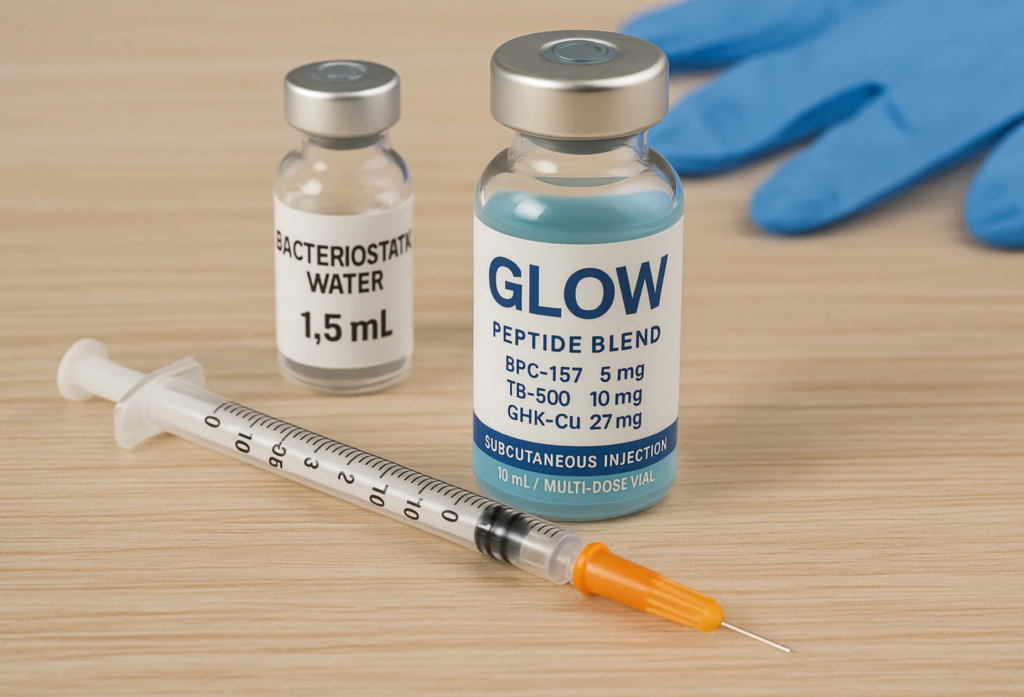
And if you are currently taking anything purchased through a social media link, a TikTok pharmacy, or someone at your gym handing it out between sets, please understand that independent testing has found that a significant portion of gray market peptide products do not contain what they claim. You may be injecting something that is not what you paid for.
Work with a real clinician. Get your blood work done. And keep lifting.
FAQ
Is it true that GLP-1 medications reduce the motivation to exercise?
Real-world tracker data presented at a major endocrinology conference in June 2026 showed measurable drops in step count and physical activity in GLP-1 users, even among previously highly active individuals. The working theory is that GLP-1 receptors in the brain reduce motivational drive more broadly, not just appetite. This is still being studied but the pattern is significant enough that researchers are taking it seriously.
What is the Stanford muscle compound and is it available?
Stanford Medicine published early research in June 2026 identifying a companion compound that showed promise in preserving muscle mass when combined with a GLP-1, without affecting fat loss outcomes. It is in early clinical trials and is not commercially available. It is not a replacement for resistance training.
How do I know if I am losing muscle on a GLP-1?
The scale will not tell you and neither will the mirror. A DEXA scan is the most accurate measure of body composition. InBody scales, available at many gyms and clinics, give a directional estimate. Getting a baseline before starting any GLP-1 and rechecking regularly is the only way to actually know what is happening to your muscle mass.
Can you prevent muscle loss on a GLP-1?
You can significantly reduce it. The primary variables are total calorie intake that is not excessively low, adequate protein, consistent progressive overload strength training, and sufficient recovery. None of those variables are automated. They require deliberate effort, which is why the activity drop data is concerning: the medication may be reducing the drive to do the things that protect muscle.
Who should consider a GLP-1 medication?
People with obesity or diabetes, people whose relationship with food involves compulsive or trauma-based eating behaviors, and people for whom other interventions have not produced results despite genuine effort. A GLP-1 is not appropriately prescribed to someone who wants to lose 10 to 15 vanity pounds, and any clinician operating within ethical guidelines should tell you that directly.
Hear the Full Episode
Listen to episode 1307 of The Chalene Show for more detailed research and a few other topics like GLPs and Hollywood, the return of scary skinny, estrogen and the brain, and more.
Love you, mean it.
Chalene
P.S. Check out my interview about GLP-1s with Dr. Kathleen Jordan from Midi Health.